
Do you doubt Bro. Eddie for electing him as president? Here are some answers to pave the way for those doubts.
Last December 2009, I prayed harder to finally decide who will be the candidate that we will be supporting for presidency this coming 2010 presidential elections. I only have two choices, Bro. Eddie Villanueva or Noynoy Aquino. I have had respect to both candidates since both of them have shown that they were not lovers of position and of money. And both simply wants to have a genuine change.
I wrote this article so to share what made me decide to go for Bro.Eddie and as I try to answer the issues being thrown against him, I hope this article will also be an eye opener to all Christians out there who doubts to support Bro. Eddie.
First, I will be presenting the most common issues being thrown against him and then my answer.
Bro. Eddie is a pastor, and pastors should not be running for government positions because his calling is to pastor not for government positions.
Ans. By far, I haven’t really seen a passage in the Bible that prohibits spiritual leader to be political leaders. In contrast to this, we can pinpoint characters in the Bible who were both political leaders and spiritual leaders. And we can see from the Bible that political leaders who were godly brings up nation.
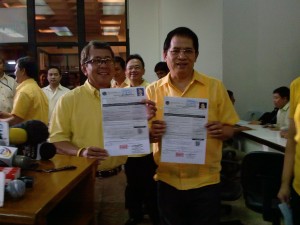
Bro Eddie And Perfecto Yasay Filing their COC
We have David, we have Solomon (at least in his early days), we have Josiah, Moses, Joshua, etc. All of them were leaders not only of a religious group but a nation called Israel. And so far, there is no clear proof that the Bible prohibits a religious leader to become a political leader.
So for Christians who hold for this position, please give a clear passage that says it prohibits a pastor for becoming a political leader. I already have read so many comments and passage quotes, but I really haven’t seen a clear and strong passage that prohibits pastors for political positions.
I believe that being a religious and political leader at the same time is just a matter of personal conviction.
Bro. Eddie is doing which is against the law. Church must be separate from the State.
Ans. This issue is very childish in approach. If Bro. Eddie’s candidacy was really illegitimate, then he should have been disqualified from the 2004 elections. But he wasn’t. Simply because his candidacy is COMPLETELY LEGAL, as provided by the Philippine Constitution.
Bro.Eddie is not a Church by the way. Reviewing the definition of a Church, a Church is not a building nor an individual person. A Church known to be the ikklesia in Greek, is a group of people who believe in a common God. Bro. Eddie’s candidacy only puts him to that position, not the whole group of Jesus is Lord Movement.
Bro. Eddie doesn’t have an experience in running the government.
Ans. I really doubt this. I strongly believe Bro. Eddie is capable in running the Philippines. One lawyer said, “If Bro. Eddie will be elected, I will give him three to six months, he will be ousted as a president.” Such statement is very common to lawyers who put their faith on Gibbo. But that is just an over statement. I do believe Bro.Eddie is highly qualified for this position.
Let’s go and check who is Bro. Eddie. Bro. Eddie is the CEO of Zoe TV. He is a businessman, the CEO/Senor Pastor of Jesus Is Lord, the CEO of Bangon Pilipinas Political Party, an economist by profession, a former activist, a professor of Polytechnic of the Philippines for years without asking for any payment. A student of law in UP College of Law.
Let me just make this clear. Bro. Eddie is not a dumb candidate. If the late President Cory Aquino, a plain housewife was able to survive several cou attempts, I believe Bro. Eddie stand a FAAAAR better chance against it. Bro. Eddie is a man with experience in leading people. We are not talking about leading a few hundreds, we are talking about millions of people.
Well, granted that he lacks some higher government positions, but seeing all his experiences, I believe he can learn it far better than the rest.
Bro. Eddie is “mayabang” claiming that he can change the nation.
We are talking about political ads. As I always here from other people, they say that Bro. Eddie should not be claiming that he is the “pag-asa ng bayan”. Again, this is only a childish talk. I believe no candidate would ever say in his ads “do not vote for me”. Let us be real, this is politics and we aim get voted right? And we should be showing what we can do. It’s like selling yourself, to be hired. I doubt if it is pride or “kayabangan”.
Well, a better way to answer this is to browse over www.youtube.com, review all the candidates’ ads and judge for your selves if who is really “nagyayabang lang.”
A good example is Gibbos’ campaign. It just ended “posible lang kay Gibbo.”
Bro. Eddie is a “compromiser” with other faiths.
Other Christians who were against Bro. Eddie is because of this issue. They say that Bro.Eddie is a compromiser. Attending inter-faith rallies, making an alliance with other religious groups, etc. In addition to this, Bro. Eddie have made some statements that is against the faith that he profess.
Well I really don’t see anything wrong with him having political alliances with other faiths. He is running for a political position remember? I also do not see any problem with that because it is more on living at peace with everybody. I believe it is stupidity to be attacking other religious groups instead of showing them the love of Christ which is all the more encourged in the Bible.
Christ even though he suffered from all those ridicules, we can see that Christ showed love to all people and did not fought back. I believe Bro. Eddie is just practicing in living at peace with everyone even of other faith.
Concerning his statements which contradicts to the faith that he profess, well, Bro. Eddie is just an ordinary person. He commits mistakes. Who hasn’t? I believe even those who criticize him committed mistakes too. To his critics who attacks him with this, “let him who have not committed a mistake throw the first stone at him.”
Bro. Eddie will only put shame to our Lord if he loses this election when his winnability is very low.
Yes, Bro. Eddie’s winnability is very low, I do agree with that. And I also agree that if that happens it will shame the name of our Lord. However, I believe that all the more that the name of our Lord will be put to shame if I, a fellow brother in Christ cannot even vote and do not even have any trust to my fellow believer.
Funny because even the Muslims trust that he can bring a change in our government, while his fellow believers doubt him more than the rest of the candidates. That’s why all the more that other groups laugh at us. Hope this will be a wake up call.
Being a part of the evangelical Christian group, I believe I should give my trust to my fellow believer and I believe as what the Bible says that all the more I should give favor to my fellow brethren in Christ. And because of this, I believe I am doing the right thing. It is not about winnability, it’s all about being one in heart, in mind, and in goals.
The problem with many Christians is they only want results without any hardship. Some are very good in criticizing but do not even takes the initiative for a change to happen.
Bro. Eddie will only promote his religious group Jesus Is Lord.
I strongly disagree with this. As Bro. Eddie along with the Bangon Pilipinas Movement, they have made it clear that running for politics for political renewal. Sad to say, the Philippine politics is in its extreme levels of corruption and degradation. If only we can renew and change the ways of the Philippine politics, then there is a bigger chance that our nation will rise up.
But let us say that Bro. Eddie will do it. So? Are we not happy that the same faith that we have received will reach more people all the more? Or, we are just criticizing him for this because we are jealous for what he achieved and can achieve? I always remember one of our mentors in seminary who said, we also have to learn to be happy when a fellow brother in Christ is being blessed.
Good thing I am not a JIL. I am just a believer of Christ.
Bro. Eddie is too judgmental against other candidates claiming only to be the “righteous one”.
I think being judgmental is out of the issue of what Bangon Pilipinas promotes. It only promotes righteous and honest governance. Those who hate that statement simply just hate correction. See for yourself and be my guest if you believe that the Philippines have a “righteous and honest government.” Proverbs 12:1 “Whoever loves discipline loves knowledge, be he who hates correction is stupid.
As I said, Philippines is already at its critical level of political degradation and political immorality. I want change, and I am sure you also want it. Why should I then put again TRAPO’s back in place? We need to change them through the power of our votes.
Conclusion
I believe there are also other candidates who can definitely bring out the change in our government, and it’s not only Bro. Eddie. And at the same time I believe Bro.Eddie can also bring that change.
I vote for Bro.Eddie simply because I believe he is the most qualified for the position and the cleanest candidate to take hold of presidential position. Furthermore, he is my brother in Christ Jesus.


lets just see.. if it’s God’s will., he will surely win.. thy will be done..
hhhmmmmmmmmmmm ….
let’s wait and see, especially considering this:
http://newsinfo.inquirer.net/inquirerheadlines/nation/view/20100505-268133/Voting-machines-fail
Just imagine this from the news!!!
“In mock elections on Monday conducted by the Comelec and Smartmatic-TIM in six towns in Occidental Mindoro, votes for presidential candidates Manny Villar and Benigno “Noynoy” Aquino III were counted for Gilberto Teodoro Jr. of the administration party, according to the Nacionalista Party (NP).”
I TOLD YOU SO!!!!
Again, from the news:
Automated cheating?
Remulla showed to reporters a tally sheet from the PCOS and a manual count.
“There were five votes for Villar, five votes for Aquino, but when it came out (in the machine), there were no votes for Villar, no votes for Noynoy and 10 votes for Teodoro,” Remulla said.
“Is this automated cheating?” he asked, adding that the inability of the machines to properly count the votes in the mock elections proved persistent talk of a failure of elections.
Comelec officials reported that in tests in three far-flung towns of Cuyo, Magsaysay and Brooke’s Point in Palawan province, the machines only read portions of the ballots containing the names of candidates for national races, according to the Inquirer’s Southern Luzon Bureau.
Similar problems occurred in tests in the provinces of Bataan and Pampanga.
Flores said that the eleventh-hour glitch surfaced Monday during testing and sealing of machines in 50 to 100 precincts to show that the automated election system is working and has no malicious data.
with this obvious failure of election, just imagine the wasted multi-million costs in buying this automatic stupidity!!!
no wonder my cousin in Comelec removed me as friend in Facebook!!!
Truth Offends!!! Always!!!!
“And how can you validate a system with a process that is also corrupted? We wanted to automate because we were so unhappy with the manual system that has been corrupted, so why are we validating a new system with a corrupted system?” De Villa told reporters.
Everything seems to be so corrupted:
men, machines, methods, and moneys —
in the mad pursuit for power!!!!
Psalms Chapter 118
8 [It is] better to trust in the LORD
than to put confidence in man.
9 [It is] better to trust in the LORD
than to put confidence in princes.
http://www.youtube.com/user/sleepymv609#p/c/3EB1E02B876E5951/1/ydsmGyngyNE
There is no law found in the Bible nor in the Phil. Constitution that Pastors, priests, etc. should not run? So, hahayaan na lang natin na ang mamahala ay ang evil or “lesser evil”? Totoo bang pinagdasal mo yan?
Where in the bible does it say that
God always gives us what we want???
Where exactly???
Do we always get what we want, and
do we always want what we get???
The story of king Saul is an illustration that God sometime gives what the people want. But it doesn’t mean it is his ultimate will. We call it permissive will.
But there are ultimate truths in the Bible concerning some of his will.
Like the following:
1. God’s ultimate will is for us to live righteously.
2. God’s ultimate will is for us to glorify him in all our ways.
3. God’s ultimate will is for us to follow his commands.
4. God’s ultimate will is for us to live in his side.
5. God’s ultimate will is for us to enjoy life while being with him.
With these ultimate truths of his will. I think it covers a wide area of our lives, such include our career, politics, spiritual life, secular life, etc.
Can we force God and twist His arms to give us what we want?
Is Bro. Eddie resorting to this game to try to win?
from: http://heargoodnews.com/members/html/modules/news/print.php?storyid=161
What’s Inside the Trojan Horse? – Christian Pragmatism
Date 2005/7/28 9:23:09
Topic: Sermon Text
What’s Inside the Trojan Horse?
by John MacArthur
By God’s grace, I have been the pastor of the same church now for almost thirty-five years. From that vantage point, I have witnessed the birth and growth of menacing trends within the church, several of which have converged under what I would call evangelical pragmatism–an approach to ministry that is endemic in contemporary Christianity.
What is pragmatism? Basically it is the philosophy that results determine meaning, truth, and value–what will work becomes a more important question than what is true. As Christians, we are called to trust what the Lord says, preach that message to others, and leave the results to Him. But many have set that aside. Seeking relevancy and success, they have welcomed the pragmatic approach and have received the proverbial Trojan horse.
Let me take a few minutes to explain a little of the history leading up to the current entrenchment of the pragmatic approach in the evangelical church and to show you why it isn’t as innocent as it looks.
Recent History The 1970s, for the most part, were years of spiritual revival in America. The spread of the gospel through the campuses of many colleges and universities marked a fresh, energetic movement of the Holy Spirit to draw people to salvation in Christ. Mass baptisms were conducted in rivers, lakes, and the ocean, several new versions of the English Bible were released, and Christian publishing and broadcasting experienced remarkable growth.
Sadly, the fervent evangelical revival slowed and was overshadowed by the greed and debauchery of the eighties and nineties. The surrounding culture rejected biblical standards of morality, and the church, rather than assert its distinctiveness and call the world to repentance, softened its stance on holiness. The failure to maintain a distinctively biblical identity was profound–it led to general spiritual apathy and a marked decline in church attendance.
Church leaders reacted to the world’s indifference, not by a return to strong biblical preaching that emphasized sin and repentance, but by a pragmatic approach to “doing” church–an approach driven more by marketing, methodology, and perceived results than by biblical doctrine. The new model of ministry revolved around making sinners feel comfortable and at ease in the church, then selling them on the benefits of becoming a Christian. Earlier silence has given way to cultural appeasement and conformity.
Even the church’s ministry to its own has changed. Entertainment has hijacked many pulpits across the country; contemporary approaches cater to the ever-changing whims of professing believers; and many local churches have become little more than social clubs and community centers where the focus is on the individual’s felt needs. Even on Christian radio, phone-in talk shows, music, and live psychotherapy are starting to replace Bible teaching as the staple. “Whatever works,” the mantra of pragmatism, has become the new banner of evangelicalism.
The Down-Grade Controversy You may be surprised to learn that what we are now seeing is not new. England’s most famous preacher, Charles Haddon Spurgeon, dealt with a similar situation more than 100 years ago. Among churches that were once solid, Spurgeon and other faithful pastors noticed a conciliatory attitude toward and overt cooperation with the modernist movement. And what motivated the compromise? They sought to find acceptance by adopting the “sophisticated” trends of the culture. Does that sound familiar to you?
One article, published anonymously in Spurgeon’s monthly magazine The Sword and the Trowel, noted that every revival of true evangelical faith had been followed within a generation or two by a drift away from sound doctrine, ultimately leading to wholesale apostasy. The author likened this drifting from truth to a downhill slope, and thus labeled it “the down grade.” The inroads of modernism into the church killed ninety percent of the mainline denominations within a generation of Spurgeon’s death. Spurgeon himself, once the celebrated and adored herald of the Baptist Union, was marginalized by the society and he eventually withdrew his membership.
The Effects of Pragmatism Many of today’s church leaders have bought into the subtlety of pragmatism without recognizing the dangers it poses. Instead of attacking orthodoxy head on, evangelical pragmatism gives lip service to the truth while quietly undermining the foundations of doctrine. Instead of exalting God, it effectively denigrates the things that are precious to Him.
First, there is in vogue today a trend to make the basis of faith something other than God’s Word. Experience, emotion, fashion, and popular opinion are often more authoritative than the Bible in determining what many Christians believe. From private, individual revelation to the blending of secular psychology with biblical “principles,” Christians are listening to the voice of the serpent that once told Eve, “God’s Word doesn’t have all the answers.” Christian counseling reflects that drift, frequently offering no more than experimental and unscriptural self-help therapy instead of solid answers from the Bible.
Christian missionary work is often riddled with pragmatism and compromise, because too many in missions have evidently concluded that what gets results is more important than what God says. That’s true among local churches as well. It has become fashionable to forgo the proclamation and teaching of God’s Word in worship services. Instead, churches serve up a paltry diet of drama, music, and other forms of entertainment.
Second, evangelical pragmatism tends to move the focus of faith away from God’s Son. You’ve seen that repeatedly if you watch much religious television. The health-wealth-and-prosperity gospel advocated by so many televangelists is the ultimate example of this kind of fantasy faith. This false gospel appeals unabashedly to the flesh, corrupting all the promises of Scripture and encouraging greed. It makes material blessing, not Jesus Christ, the object of the Christian’s desires.
Easy-believism handles the message differently, but the effect is the same. It is the promise of forgiveness minus the gospel’s hard demands, the perfect message for pragmatists. It has done much to popularize “believing” but little to provoke sincere faith.
Christ is no longer the focus of the message. While His name is mentioned from time to time, the real focus is inward, not upward. People are urged to look within; to try to understand themselves; to come to grips with their problems, their hurts, their disappointments; to have their needs met, their desires granted, their wants fulfilled. Nearly all the popular versions of the message encourage and legitimize a self-centered perspective.
Third, today’s Christianity is infected with a tendency to view the result of faith as something less than God’s standard of holy living. By downplaying the importance of holy living–both by precept and by example–the biblical doctrine of conversion is undermined. Think about it: What more could Satan do to try to destroy the church than undermining God’s Word, shifting the focus off Christ, and minimizing holy living?
All those things are happening slowly, steadily within the church right now. Tragically, most Christians seem oblivious to the problems, satisfied with a Christianity that is fashionable and highly visible. But the true church must not ignore those threats. If we fight to maintain doctrinal purity with an emphasis on biblical preaching and biblical ministry, we can conquer external attacks. But if error is allowed into the church, many more churches will slide down the grade to suffer the same fate as the denominations that listened to, yet ignored, Spurgeon’s impassioned appeal.
Make it your habitual prayer request that the Lord would elevate the authority of His Word, the glory of His Son, and the purity of His people in the evangelical church. May the Lord revive us and keep us far from the slippery slope of pragmatism.
See: http://internet-churches.com/pragmatism.htm
If Bro. Eddie really believes that he is the anointed and it is God’s will for him to run this country, does he really need the votes from notorious cultists like ACQ and INC????
Quibuloy is a false prophet of profit!!!!!
Why do Bro. Eddie have to court his votes and supports??
Similarly, why would he also rub elbows with Manalo of INC who also promised to endorse him??
Just how desperate is he really to rake votes from these cults???
Is the anointed son of God, Quibuloy, who a JIL pastor said to have earlier endorsed Bro. Eddie’s anointedness as the incoming president, vacillating from his earlier endorsement?
http://newsinfo.inquirer.net/breakingnews/nation/view/20100420-265439/Influential-pastor-warns-of-failure-of-elections
Hmmm… there was only a conclusion, but no formal announcements has been made yet. Quiboloy is not endorsing Bro.Eddie. SOme of JIL members misinterpreted the good relationship of Bro.Eddie with Quiboloy.
Pero ako, ayoko umasa jan kay Quiboloy. Nagpaplay safe lang yan sa mga prophecies nya. Parang manghuhula, “magingat sa pagtawid, baka masagasaan.”
hhhmmmmm …. from a JIL pastor, cult pope Quibuloy supposedly endorse Bro. Eddie’s anointedness as God’s will to be the president of our country.
So, why has he changed his mind and vacillated from his earlier endorsement for Bro. Eddie?
http://newsinfo.inquirer.net/breakingnews/nation/view/20100420-265439/Influential-pastor-warns-of-failure-of-elections
correction:
Yes, Bro. Eddie was called to be a pastor for the past years, but now GOD is calling Bro. Eddie to lead the country.
Are you telling us that God spoke directly to Brother Eddie?
Why is he so gifted and so blessed?
Are you saying God like him more than us, that’s why God talks to him and NOT us?
Are you saying God plays favorites by making Bro. Eddie THE chosen one?
Are you saying that if God, assuming that what you’re saying is real, did not choose others they also have no right to be the leader of the Philippines?
So God plays favorites?
I am looking for that in the Bible but I cannot find it. And to think that I’ve read the Bible all my life?
So why are you so gifted to interpret the words of God for me?
Are you saying you are wiser and more gifted than I am?
Are you saying, therefore, that I am more ignorant than Bro. Eddie and you because I cannot understand God in your ways?
WOW!
@Wawa We
What do you think?
@Wawa, I am really trying to figure out to whom you are addressing your comment. If it is for Beth, I really don’t understand why your comment should be like that?
I haven’t seen Beth to showing that she is a good interpreter and that God works better in her than you.
Hmmmm… please clarify.:)
.-= Vince´s last blog ..Illustrations About Temptation =-.
I am for Bro. Eddie, because he is the only man I know who did not stop and continously praying for the country (I have known him fro 30 years). I have learned to pray everyday for the Philippines and love the country because of him. If he influenced me with that attitude, I sure believe, that as a president, he will influence as all the more to love the Philippines.
Yes Bro. Eddie was called to be a pastor for the past years, but now god is calling Bro. Eddie to lead the country. He is only obeying what God is telling him to do.If not for the love of country, he will be choosing to stay in his comfort zone. But NO. Bro. Eddie cannot live without doing the will of God.
I believe Bro. Eddie is the only qualified candidate for God to use so that God’s plan, purpose and agenda for the Philippines will happen.
Let us pray everyday for the Philippines and for the coming election!
GOD BLESS THE PHILIPPINES!!!!!!!!!!!!!!!
I am for Bro. Eddie. Pray for your vote!
in 2004 election i didn’t vote…now i will vote and i will vote for bro. eddie..thanks
Ernesto Adorio – Doc Ernie’s Adventures in the Web – Public – Muted
Getting to know more the ugly truths about Manny Villar.
One of my favorite writer, William Esposo, aka the Chair Wrecker is at it again, debunking the myth of Villar slick political commercial how his brother Danny died since they were too poor to buy…One of my favorite writer, William Esposo, aka the Chair Wrecker is at it again, debunking the myth of Villar slick political commercial how his brother Danny died since they were too poor to buy medicines ?
Visit
How Manny Villar lied and used the death of his brother Danny
http://www.philstar.com/Article.aspx?articleId=562010&publicationSubCategoryId=64
The conclusions of the Chair Wrecker are mind troubling:
With the propagation of this ONCE POOR fantasy, don’t you think that Manny Villar also desecrated the memory and honor of his parents who strove to be able to provide their children quality education and an upper class domicile?
If Manny Villar can lie and use his dead younger brother like this, what makes you think that he will really improve and not worsen your life? What makes you think that he is not as greedy as he is being charged in this presidential campaign? What makes you think that you can trust Manny Villar?
Read his article and tell us your reactions in the comment box.
How are the many prophecies of Bro. Eddie’s winning the 2004 and 2010 Presidential elections any better than this following kind of prophecy about the US Presidential election???
http://moriel.org/MorielArchive/index.php/discernment/church-issues/false-prophets/pat-robertson-false-prophet-again
Regarding prophecies for the elections, especially for those prophesied to win:
http://www.deceptioninthechurch.com/fprophet.html
Ang hirap yata kung ipagyayabang natin kung anong nagawa natin para sa bansa!!! May mga ganon palang mga Christian-kuno: nagbubuhat sa sariling bangko!
Di ko na lang sabihin anong mga sakripisyo ang nagawa ko para sa bansang ito, kasi nakakahiya magyayabang at hindi ko ugaling magbubuhat sa sarili kong bangko. Baka yong iba dyan, masayang magyayabang sa mga mabuting gawa nila!!
There are many non-sequiturs and argumentum ad hominems, among other propagandistic devices argued by some people here. But since the issue of the elections is really so controversial, there is no point to further muddle the related issues, which some people don’t want to consider in context and relevance to the discusssions here.
To make the long argument short:
It’s up to you and to others who, how, and why they vote!
Or not to vote!!!
So funny how some holy people here condemned those who didn’t vote for Bro. Eddie in the 2004 elections!!!
But what ever so happened to the many prophecies that it was God’s will that he would win and become the president of the country? No censure from the supposed Christians?
Double standards?
And there are again prophecies in some churches saying that again it is God’s will that he would win this 2010 elections! If he won’t win, whose fault is it? If he would win, does it really follow that it is God’s will?
In the 2004 elections, there were also prophecies that said that GMA would win and would be God’s will. GMA won. Can we say that the prophet who prophesied GMA’s victory had more “pogi points” before God than the prophet who prophesied Bro. Eddie to win?
My curiosity can really kill a cat regarding how the holy people can use their own kinds of reasonings and argumentum ad hominems especially in condemning those who do not agree with their holy convictions!!!!!!!!!!!!!!!
ROTFLOL ROTFLOL ROTFLOL ROTFLOL …..!!!!!!!!!!!
Wwwwooooowwwwoooowwwwoooowwwwoooowwwwoooowwwww!!!!!
This is indeed a very complicated and divisive issue!!!!!
Imagine how some people here wallow in argumentum ad hominems in condemning those who do not agree with their oersonal convictions! Talking about the tolerance Christians are supposed to have with those who may not believe nor behave like their sanctimonious holinesses!
Maybe, before some people would condemn others for not agreeing with them, they should study first all the relevant issues and contextualized say with what had been posted here. Not ran over those who they look down as less than a Christian, because those they look down just so happen to think, believe, and feel so differently than they!!
Again, nobody is stopping anybody from casting their votes to whoever they believe can represent their interests! And in the same manner, nobody should stop others from boycotting something that they believe to not represent their interests!!!
Such is democracy — the enjoyment and exercising, or not exercising, the inalienable rights and freedoms enshrined in the constitution!!!!!!!!
Just my $0.02 piece of personal opinion!!!!!!!!!
from: http://www.debone.com/boycott.html
Why Boycotting Is The Most Important Democratic Tool Regardless Of Your Political or Philosophical Disposition
Why? In a word: money. Regardless of whether or not you are a Democrat, Republican, Libertarian, Green, independent, etc., when your only power in influencing the choices of your government is through your vote to elect one of a few running for a primary or an office, if none the candidates running represent your interests, your vote can do little to help your cause. However, if you are aware of money trails that support what you are for and those that support what you are against, patronage (purchases, donations, etc.) or lack there of (boycotting, etc.) can have a more meaningful and immediate effect, especially at the level of local or smaller scale business or organization.
Armed with information of the money flow, any true democracy (and even a republic such as the USA) can become a healthy (relatively corruption free) patriotic capitalistic democracy.
Why Boycotting Is An Important Option For A Healthy Patriotic Capitalistic Democracy
Capitalism is “an economic system characterized by private or corporation ownership of capital goods, by investments that are determined by private decision rather than by state control, and by prices, production, and the distribution of goods that are determined mainly in a free market.”
Democracy is “a government in which the supreme power is vested in the people and exercised by them directly or indirectly through a system of representation usually involving periodically held free elections.”
The key to healthy patriotic capitalistic democracy, then, is an economy with a “free market” with a government “in which the supreme power is vested in the people.” Note that in a true democracy, capitalism is not necessarily present as it depends on the will of the people. In fact, most likely any “true” democracy would include many forms of economic systems, coexisting and interdependent, reflecting the varied views, needs and aspirations of the population involved. One could argue that this is in fact a valid description of the US economy to some extent. Technically the governance of the US is not a “democracy,” but rather a republic, which by it’s nature is much more prone to the corruptive influence of money, blackmail, etc.
It is also good to use this right while you still can. In this century, the US has enacted laws to take away some of these rights. Though they generally don’ t effect most citizens directly and may not in fact be enforced, they do illustrate that threat to the right to choose where to make a purchase (see “What Interferes With A Free Market” and “Anti-boycott Laws” below).
RIGHT TO BOYCOTT, MONEY TRAILS & EFFECTIVE USE TO COMBAT CORRUPTION
Want to help roll back corruption in government and industry? The use of boycott coupled with increased democratic activities by ordinary citizens can make this happen. (See also A Little Democracy Is a Danerous Thing” for the need for local and regional democratic activity & Your Economic Vote: Your Influence On Politics And The Economy” for examples of industries with issues and alternative sources.)
http://www.debone.com/boycott.html
THE RIGHT TO BOYCOTT- ne plus ultra
Boycott:
To shut out from all social and commercial intercourse:
to refuse to take part in, deal with, handle by way of trade etc.”
— Chambers 20th Century Dictionary
http://www.cuts-international.org/Right-Boycott.htm
An inalienable right:
Boycotts and rights
There can be no question, in my mind, that any individual has the right to boycott any business or any other individual for any reason they wish. These reasons can be rational or irrational, motivated by hatred or motivated by a more nobler feeling.
For more to read:
http://freestudents.blogspot.com/2009/01/boycotts-and-rights.html
The platform is more of ecumenical nationalism, rather than pushing for moral and spiritual revival to change the people and transform the gov’t using biblical principles.
So, it’s not surprising if the compromising Christian candidate would easily rub elbows with cultic and pseudo-Christian sects so as for him to rake votes (e.g., with the block-voting culture of the INC — kamag-anak ng candidate yata ang nanay ng head ng INC!). So, his political movement is more on nationalism and ecumenism, not really along moral and spiritual revival of the people and gov’t via true Christian principles!
The worse thing is to use “false prophecies” to predict his victory. The false prophecies already failed the last time he ran. What would assure that the updated prophecies of his victory would be fulfilled. Assuming those prophecies would be fulfilled, does it really follow that his victory would be the will of God? How would that prophecy be any better than Madame Auring’s divinations??
Politically correct compromises erodes Christian integrity!
If a Christian lacks integrity, then how is he any different from those who you so despise?
Double standards?
Read again on the sermon on the problem of a Christian or a church that compromises with sin!
If your candidate already make politically correct compromises now, what makes you think he won’t be making more politically correct compromises in the future if he would sit in power?
Political compromises lead to political debts that must be paid later. So, just how pure and incorruptible really is your candidate??
You don’t read on the related theological issues of Christians who are compromising …. by all means, vote for a compromiser, and then make your own compromises!!!
Standards?
Just consider the problems of reliability, credibility, and integrity, not only on the political and voting process, but on the technology itself to be used to fool the voters again ang again ….
So, if your technology itself is unreliable, no credible, and lack of integrity, then how can you be so blind to put faith on the outcomes??
You didn’t read the earlier related post on the technological issues!!
hahahahahaaaa …..
To vote or not to vote is a democratic right!
To be bought or not to be bought is a personal right!
To boycott or not to boycott is also a democratic right!
Nobody is stopping you to vote, but you can not stop others to boycott also!!
Walang pilitan kahit kanino!!!
http://en.wikipedia.org/wiki/Christian_anarchism
Oggie,
To vote or not to vote?
– WHAT!!! If you would not vote, then why such comments?? How can you help or convince us on who to vote?!!! This article is for people who are planning to vote but are still in the process of choosing who to vote. Clearly you don’t understand what this article is all about.
To be bought or not to be bought?
– Then what are your standards?!!! You haven’t answered this question yet.
Oggie,
To vote or not to vote?
– WHAT!!! If you would not vote, then why such comments?? How can you help or convince us on who to vote?!!! This article is for people who are planning to vote but is still in the process of choosing who to vote. Clearly you don’t understand what this article is all about.
To be bought or not to be bought?
– Then what are your standards?!!! You haven’t answered this question yet.
i don’t want to make it complicated.
if u can give me a better choice as an agent of real change than bro. eddie, i might consider.
but as i see it, all the major presidential candidates are all traditional politicians. i’m tired of them.
i’m for bro. eddie!
To oggie the pogi! or pa pogi lang!
ang dami mo sinabi oggie dka naman ata boboto! sino ba iboboto mo matalino ka masyado! sabihin mo na kasi kung sino iboboto then prove it kung karapatdapat nga sya! nililito mo lng lalo ang iba!
Who profits in compromises?
Is being pragmatic in politics doing God’s ways in God’s thoughts?
A related issue below:
Pastors or Prostitutes?
By Mark Riddle, Pastor
Warning: prostitutes might feel offended by constant references to being like pastors. So are you a pastor or a prostitute? Seems like an obvious enough question. Maybe not.
Have you ever substituted prayer and spiritual depth for programs and religious activity. Simply keeping the people we’re charged to lead to the Most High busy, is the job of a prostitute pastor.
Sacrificing self, calling, and private devotion for the golden calf of religiosity that amounts to idolatrous (worship of things or people other than God) and adulterous (cheating on our true love) activities. All in
exchange for money. (stop giving them what they want and you’ll find yourself looking for a new place of employment).
Most pastor prostitutes make the choice to sell themselves. Many were hired to get the job done, quite simply because they could. They put together resumes about how they will “make things happen”. They are interviewed about how many activities they will have, what they will look like and how many people will attend. I’ve been there. I’ve sold myself. Hey.. It’s exciting, there’s a certain thrill. If I make enough things happen, satisfy enough folks, soon you’re perceived to be a great pastor. But I wasn’t a great pastor. I was a great programmer. I was a great speaker. I always had the right answer for people’s problems. Soon enough I was thinking, “I’ll be like God”…..not that I noticed my completely flawed theology, or my utterly ridiculous stance.. But I had fallen into what many pastors fall into.. First innocently speaking and leading people toward God…then deep down thinking I might be like God.
At some point living in this “one country under God” we have become “one country under god” (ie.me). We are the consumer church. The Bride is no longer seeking the groom… it is now seeking self glorification veiled in vigorous religious activity for the self-improvement of it’s multitudes. …”self improvement is masturbation”-tyler durden… while pastors across this
“great country” are getting themselves off to programs they have created “to the glory of god”, others develop a sort of “program envy” wishing that their program was as big and aspiring as First willowback, saddlecreek or over there on mars hill. Though we may not have started this “towering idol” of consumerism we all fall into it and I would venture to say… none of us truly has any idea how deep we are in.
My friends suggest we are all in deeper than we think. We perpetuate all this self-indulgence consumer crap in most of what we do. We ask “what makes our church unique to this city?” as our Ikea-congregations are trying to figure out which local “building-based group of people who call themselves Christians” best represents me as a person, we are well on our way to helping folks categorize themselves away into superficial oblivion. …I drive a $50,000 Range Rover because I like the idea of being perceived as an outdoorsman, heaven forbid, I drive a mini-van… I own a $375 North Face Gortex though I only ski once or twice a year, it promotes the idea that I’m an outdoorsman… though I never camp… that’s what I think of myself…. I go to ________ Church because it will make me a better businessman, and my kids the homecoming queen and football captain. Jesus is a great enhancement into my almost complete life.
Pastors forsake Christ and following him, for lots of people being busy in the church, and a whole lot of rules and slogans like “church should be fun” or “Jesus is cool”…try telling a Christian in Sudan either of these completely bogus lines of sh*t. I’m tired of youth pastors prostituting themselves to parents for a “fine religious education”. Most of them are young enough to sense they’re selling out. I’m tired of arrogant evangelical pastors seeking to have people with perfect theology, teaching propositional truths based on poor hermeneutics or sheer laziness. Demons have good theology and the “morning star” knows the scripture better than any student enrolled in the newest bible bowl competition. But many ministers still get a “theological
woody” at the Platonic idea that education changes behavior. But why would anyone not do what the people of the congregation want. I mean after all we are here to serve them.. would you like fries with that sir?
“am i buggin you…. don’t mean to bug ya” – bono
Mark Riddle is a pastor from Tulsa, Oklahoma and the Co-founder of Liquid Thinking, Inc. He is the husband of Pam and the father of “2 kids.” He writes: “here is a fun little piece I wrote recently, if you find it interesting let me know.”
Is it God’s way for people, persons, priests, popes, pastors, prophets, etc. to prostitute precious prime principles and practices for their political and personal profits???
Especially in making blatant compromises by sacrificing separation from the world’s evil ways, so as to desperately win popular votes???
Is it really for personal profit???
Surely, there are political profits!!!!!!!!!
Nobody enters politics if there are no political profits!
That’s the obvious given!!!
Is there really a significant separation between the personal and the political if one is engage in political games???
Even for the most hypocritical politician who plays political correctness to the hilt????
Nakakaawa naman ang taong ito.. You truly need Christ in your heart to be free from all your baggages and be happy.. Men think they are wise in their own eyes, but to God they are foolish.. Nakakaawa ang puso mo kung sino ka man, may God work miracles in your life..
God’s way are our ways, God’s though are not our though
God ways are not your ways, God though are not your though
from: http://www.visionforum.com/hottopics/blogs/dwp/2008/01/3351.aspx
Biblical Principles of the Ballot Box
More important than who wins or loses the 2008 election is this: will Christians look to the Bible as their absolute standard for determining what principles must guide their voting practices? At stake is far more than the presidency. The question concerns the conscience of the Church. We can “win” an election, and yet sell our spiritual birthright. Conversely, we can “lose” an election yet remain faithful to the Word of God, thus preserving the conscience of the body of Christ and enjoying the favor of the Lord.
Elections matter. They matter a great deal. But what matters the most is that the Church remains faithful to her Bridegroom by following the only infallible standard ever written for the selection of civil magistrates. That standard is the Bible, and there is none other that perfectly reflects the mind of God. It is our source book for determining what guidelines must govern the selection of our leaders.
Some believe that the Bible is silent on the question of what standards should govern the selection of a civil magistrate. But to reach this conclusion is to deny the sufficiency of Scripture, and to substitute autonomous human reason for biblical revelation. Others are so fearful of certain outcomes, that there is little reasoning with them. These individuals are (no doubt, unwittingly) fixed on specific outcomes, not commitment to biblical guidelines. They want to condemn their brethren by saying that a vote for X, is really a vote for Y. Their election fears seem sometimes to rise to a self-righteous hysteria, governed more by emotions than objective standards. None of these approaches are helpful.
The Bible is the only answer for fearful Christians in an age of politics. The Bible has the answer to the ethical chaos of fear-driven voting, pragmatic voting, “ends-justifies-the-means” voting, and “lesser-of-two-evils” voting. The Bible does not require Christians to vote for perfect candidates, but it does require that Christians support biblically qualified candidates. Biblical Principles of the Ballot Box explores the Scriptural standards for selecting civil magistrates, and offers great hope for Christians living in an age in which our leaders have broken covenant with the God of their fathers. It explores the blessing presented in Scripture to all who will enter the ballot box with supreme confidence that the Lord sovereignly reigns, that He is more pleased with our obedience than with our rationalistic, extra-biblical voting strategies, and that the greatest hope for America is not found in the outcome of any one election, but in the persevering witness of the Church as God’s representative in America, to uphold his non-negotiable standards and righteousness.
Biblical Principles of the Ballot Box is our gift to anyone who supports Vision Forum Ministries during the remainder of the month of January with a donation of any amount.
Posted by Doug Phillips on January 28, 2008 | Permalink
ShareThis
So, has Bro. Eddie REALLY, REALLY met the impeccable standards set by the word of God??
The answer, my friend, is left as an assignment for the voter to figure out for themselves!!!!!!!!!!
For some more related answers to have some clearer, more authoritative, undeniable, biblical standards regarding choosing those who we want to rule over us, taken from a related post, but so very, very relevant here:
http://www.visionforumministries.org/issues/ballot_box/biblical_standards_for_choosin.aspx
Biblical Principles for the Ballot Box
Biblical Standards for Choosing Civil Magistrates
by William Einwechter, July 7, 2004
The conscientious Christian desires to glorify God and obey His Word in all that he thinks and does. This desire extends to his actions as a Christian citizen. Perhaps one of his more important actions as a citizen is that of voting for the men who will serve as magistrates over him. So as each election draws near he seeks to determine which candidate he should endorse with his vote. Throughout the process of deciding he receives much advice, such as: vote Republican; vote for the conservative; vote for the one who is pro-life; vote for the one who stands closest to you on the issues; vote for “x” even though he is less than desirable because if he doesn’t win, then we will have “y” who is even worse; and so on.
However helpful this kind of advice may be, the Christian who believes that the Word of God is able to instruct him in righteousness and equip for every good work (2 Tim. 3:16-17 ), including the work of voting, will necessarily turn to the Scripture for guidance. The Bible contains explicit instructions concerning the qualifications for civil officers, and to these the Christian ought to look as he determines who he will support with his time, money, and vote. There are two primary texts that set forth the standards for choosing civil magistrates: Exodus 18:21 and Deuteronomy 1:13 .
Exodus 18:21
In Exodus 18 , Jethro, Moses’ father-in-law, advises Moses to appoint men to help him in governing and judging the nation, lest he wear out both himself and the people (18:17-19 ). An important aspect of Jethro’s counsel to Moses is in regard to the kind of men that he should appoint as rulers. The character of the men chosen must be according to the following standards:
“Moreover thou shalt provide out of all the people able men, such as fear God, men of truth, hating coveteousness…” (Ex. 18:21 ).
Men who are able
Civil leaders must be men of strength. The strength that is required here is not primarily physical, but moral and spiritual. It refers to men of valor and of virtue; men of courage and of character. A man who is a coward will not fulfill his duty to uphold God’s law if doing so would be unpopular with the people. A man who is of an evil character cannot govern justly. Only those who have proven that they have the ability, courage, and integrity necessary to lead should be chosen as civil rulers.
Men who fear God
Magistrates should be men who honor and reverence God and His Word. This qualification indicates that only those who are believers, i.e., stand in covenant with God through faith, should be considered for the office of magistrate (cf. Deut. 17:15 ). If a people are to have wise and understanding leaders, they must choose those who fear God, for the “fear of the Lord is the beginning of wisdom” (Prov. 1:7 ). Men who do not fear God are, according to Scripture, “fools” who hate true wisdom.
Men committed to truth
Civil rulers need to be men who stand firmly and faithfully for the truth. Men of truth are men who do not lie, but speak the truth even to their own hurt. They love the truth and hate all that is false. It is absolutely essential that civil leaders be men who can be trusted to speak the truth. Liars and lovers of falsehood are a scourge to those they lead.
Men who hate covetousness
A man who is raised to the position of civil magistrate must be one who seeks no unjust gain from his position. He must “hate” (not simply dislike, but hate) the thought of using his office to enrich himself through violence, fraud, bribes, etc. A coveteous magistrate will try to use the power of his office to unjustly seize for himself the wealth of those he governs. A magistrate must also hate covetousness in others, and not allow any citizen to use the power of civil government to seize the wealth of his neighbor through unjust legislation or confiscatory taxation.
Deuteronomy 1:13
In Deuteronomy chapter one, Moses recounts the events that took place forty years earlier at Mount Sinai. One of these events was the appointment of rulers to serve with him in governing the nation in accord with the advice of Jethro (Ex. 18:13-26 ). In speaking of the appointment of rulers he does not mention Jethro, for Moses knew that God was using Jethro to direct him in that circumstance. The account of the appointing of rulers to assist Moses in judging the people given here provides further insight on the biblical standards for the choosing of rulers.
First, Moses indicates that although he did the appointing, it was the people who actually chose their own rulers. Moses charges the people to “take you wise men….” The word “take” means to provide or choose, while the word “you” means for yourselves. Therefore, Moses gives the people the responsibility of selecting their own leaders. Moses then appointed (installed into office) those chosen by the people.
Second, Moses provided the people with specific standards for determining which men were qualified for the office of civil judge and ruler. The citizens have the responsibility of choosing their own rulers, but they are not free to choose whomsoever they will. Rather, they are charged by Moses to choose only those who meet certain qualifications. Moses states:
“Take you wise men, and understanding, and known among your tribes, and I will make them rulers over you.” (Deut. 1:13 ).
These qualifications summarize those stated previously in Exodus 18:21 and provide additional commentary on the standards God has established for choosing rulers.
Men
The Hebrew word translated “men” in this text refers to males as opposed to females. The generic term for mankind, which would include women, is not used here, but rather, the gender specific word for men. If the choice of words means anything, then it is necessary to conclude that God intended that only men be chosen for the office of civil ruler. In Exodus 18:21 the same Hebrew word is used; in fact, in every other passage dealing with the civil magistrate, his duties, and his qualifications, men are in view (cf. Deut. 17:14-20 ; 2 Sam. 23:3 ; Neh. 7:2 ; Prov. 16:10 ; 20:8, 28 ; 29:14 ; 31:4-5 ; Rom. 13:1-6 ). The order of male headship established at creation applies to each of the three “governments” established by God: the family, the church, and the state. [1]
Men who are wise
The Hebrew word for “wise” means to be skilful, prudent, intelligent, or able. It denotes both natural ability and wisdom attained through experience. But wisdom in the biblical sense is never just prudence and skill gained through experience. According to Scripture, wisdom begins with the fear of the Lord and proceeds to a knowledge of God and His precepts. True wisdom comes from God as a man searches for it in the Word of God as he would search for hidden treasure (Prov. 2:1-8 ). Such a man will come to “understand righteousness, and judgment, and equity, and every good path” (Prov. 2:9 ). Thus, a magistrate should be a man of ability and intelligence who is skilled in judgment because of his fear of the Lord and his knowledge of God’s Word.
Men who are understanding
To be “understanding” is to be discerning, to have the ability to make a proper judgment. It refers primarily to moral insight and ethical discernment. A man of “understanding” is able to discern the right course of action based on the moral law of God. In terms of civil law, a man of understanding knows what is just and is able to judge righteously in disputes or criminal cases because he understands God’s law.
Men who are known
These are men who have proven themselves to be wise and understanding. Their character, ability, and wisdom have been demonstrated by their service in other spheres. A man who would be a ruler must first prove himself in family life, business, community service, church service, etc.
Summary
The biblical standards for magistrates given in Exodus 18:21 and Deuteronomy 1:13 give citizens a sure guide for determining which men among them are truly fit to serve as their civil rulers. The qualifications given in these texts indicate three areas of concern:
Natural Ability
The demands of being a magistrate require men who are intelligent and have the skills necessary to lead others.
Personal Integrity
Magistrates must be men of the highest personal character. They must be men of truth and virtue. Their lives should be an example of righteous living. As those charged with enforcing God’s law in the civil sphere, they should keep all aspects of God’s moral law. They must be men who are there to serve God and man, and are not there to enrich or promote themselves.
Spiritual Maturity
Magistrates, as ministers of God, should be men of spiritual attainment (a knowledge and fear of God) and biblical wisdom. It is vital that a ruler knows that he is accountable to God and has a healthy fear of the day that he will give account to God. A ruler must also be knowledgeable of God’s law as it is revealed in Scripture so that he can carry out his duty of establishing justice in the gates (i.e., in the courts and legislatures of the land).
Other Relevant Scriptures
The standards for choosing magistrates as established in the law of God are carried out, amplified, and upheld throughout the rest of Scripture.
Deuteronomy 16:18-20
After Israel has taken possession of the land it will be their duty under God’s law to select judges and officers to carry out judgment in the gates. These rulers are charged to “judge the people with just judgment.” Hence, it follows that the people should choose “wise” and “understanding” men who will be able to do just that. It is right to assume that the standards Moses taught them in Deuteronomy 1:13 should be applied to the choosing of local magistrates since no new or different standards are given here.
Deuteronomy 17:14-20
This text addresses the circumstance of Israel seeking a king to rule over them. It further establishes the responsibility of the people to choose their rulers, in this case, their king. However, they are not at liberty to choose whomsoever they will, but only the man approved and chosen by God. Furthermore, the man they choose must be a “brother,” i.e., a man who stands in covenant with God through faith; he must not be an unbeliever, but one who fears God as stated in Exodus 18:17 .
2 Samuel 23:3
In this text it is plainly stated that “He that ruleth over men must be just, ruling in the fear of God.” Righteous men who govern according to God’s law as God’s ministers is always the biblical standard.
2 Chronicles 19:6-7
These verses contain the instructions of King Jehoshaphat for the judges that he appointed in the land, city by city:
Take heed what ye do: for ye judge not for man, but for the Lord, who is with you in judgment. Wherefore now let the fear of the Lord be upon you: take heed and do it: for there is no iniquity with the Lord our God, nor respect of persons, nor taking of gifts.
The charge given by the king reflects the standards for choosing magistrates given in the law of Moses. Only men who “fear God,” who are “able,” “wise,” “understanding,” and “hate covetousness” could possibly fulfill the duties spoken of by Jehoshaphat.
Nehemiah 7:2
After the walls had been rebuilt and the Levites appointed to serve in the Temple, Nehemiah continued to restore the integrity of Jerusalem by establishing Hanani and Hananiah as civil rulers in the city. Nehemiah specifically stated that he chose Hananiah because “he was a faithful man who feared God above many.” Nehemiah followed the standards of the law of God in appointing the leaders of Jerusalem. As a “faithful” man, Hananiah is firm in his stand for truth; he is a man who is known for his faithfulness to truth; thus, he meets the qualification “men of truth.” Hananiah is also a man who fears God “among many.” He has proven himself as a man of spiritual maturity who is qualified to lead others.
Proverbs 29:2
The biblical standards for choosing magistrates instruct citizens to select righteous men. This verse emphasizes the great importance of selecting righteous men by stating: “When the righteous are in authority, the people rejoice: but when the wicked beareth rule, the people mourn.” This proverb teaches that it is great folly to elevate wicked men to civil leadership, but great wisdom to follow God’s law and elect only men who fear God and obey His Word.
Romans 13:1-6
The nature and purpose of the magistrate’s role is defined by Paul in this classic text on civil government. Paul explains that the authority of the civil ruler comes from God, and that the ruler serves as God’s minister to exercise God’s vengeance against evildoers. This description of the nature and purpose of the office of civil ruler applies to all rulers in all nations at all times; no exceptions are given by Paul. Thus, the same role that was assigned to magistrates in the Old Testament is assigned to magistrates in the New Testament (cf. Deut. 1:16-17 ; 16:18-20 ; 2 Chron. 19:6-7 ; Prov. 16:10, 12 ; 31:8-9 ). If the role is the same, then it must be that the qualifications are the same.
Application
The biblical standards for choosing civil magistrates needs to be applied today in the following manner:
* The only men who are truly qualified for civil office are those who meet the standards set down in the Word of God. God is sovereign over civil government, and the sole prerogative to establish what kind of men can and ought to serve as magistrates belongs to Him. Men who do not meet the biblical standards are not fully fit to serve as rulers.
* These standards instruct citizens who have the liberty of choosing their civil magistrates on how to carry out their duty in accord with the will of God. It is God’s revealed will that His ministers in the civil sphere be men who fear Him. God’s blessings are on the people who choose men of ability, character, and spiritual maturity.
* Christians should support with their time, money, and vote those men who meet the biblical qualifications. In all that he does the Christian is to seek to glorify God and promote the kingdom of our Lord Jesus Christ. When the Christian gives his full support to men who meet the biblical standards for civil magistrates, he is doing these very things. If we are to have righteous civil government, then we must have righteous men as rulers. If we are to have a civil government that honors Christ, then we must have men who honor Jesus Christ as civil leaders.
* Voting for a biblically qualified candidate who appears to have no chance of winning is not the waste of a vote, it is obedience to God. Obedience to God is never a waste of time or effort, but the compromise of biblical truth always is. Compromise sacrifices victory in the long run for the sake of immediate “success” or “peace,” while godly obedience sacrifices immediate gratification for the sake of ultimate victory. Christians often complain that there are no godly men to vote for, but when one does appear, they don’t vote for him anyway because, they reason, “he can’t win.” Can we expect the Lord to give us qualified men as candidates for civil office if Christians are not committed in principle to supporting them in obedience to biblical law?
* The church must labor to raise up men who will meet the biblical standards for magistrates. Where will men come from who are qualified for civil office if not from the covenant people? If there are no men qualified for a particular office, it is because the church has failed; it is not because the biblical standards are unworkable in the present context. The goal of the church should be to have a biblically qualified man running for every civil office in the land. We are a long way from reaching this goal. But the church must begin by equipping men to serve as magistrates and challenging them to glorify God as His minister in the civil sphere. Race by race, office by office, the church needs to take dominion over politics by raising up biblically qualified men.
* The biblical standards for choosing magistrates apply even in non-covenanted nations. This would seem evident when Christians have a biblically qualified candidate to vote for, i.e., God’s law commands them to vote for the man who meets the biblical standards even though they are in a nation not formally in covenant with God. But how does the biblical teaching on choosing magistrates apply in instances where there are no candidates who meet the biblical standards? This is debated among Christians. Some advocate strict compliance with the biblical standards at all times and all places. Others argue that strict compliance is only fully possible in a covenant nation (which is the goal); in the meantime, we should use our vote to support men of ability and integrity who are generally in agreement with biblical standards of law and justice.
* In a true Christian nation, the biblical standards for choosing magistrates will be part of constitutional law. A nation that is in covenant with God through Christ will express this by means of a national confession of submission to God and His law, and by a religious test for office that is based on the biblical qualifications for civil rulers.
* The biblical standards for choosing civil magistrates also provides a benchmark for men already in office and for men seeking the office. Every Christian in political office should evaluate himself in light of these standards; this is the kind of man he is to be. For those Christian men who are contemplating political office here are the standards that they should aspire to.
Endnotes
1. For a more detailed defense of this point, see my article Should Christians Support a Woman for the Office of Civil Magistrate?
About the Author
William Einwechter (Th.M.) is an ordained minister and an elder at Immanuel Free Reformed Church in Ephrata, Pennsylvania. He and his wife, Linda, are the homeschooling parents of ten children.
“The strength that is required here is not primarily physical, but moral and spiritual.”
Issues
* Biblical Principles for the Ballot Box
* Cross Examination
* Distinctively Biblical Education
* The Biblical Family
* God’s Hand in History
* Historic Controversies
* In Defense of Life
* News and Reports
* The Rule of Law
* Uniting Church and Family
* Women in the Military
Related Articles
* Should Christians Support a Woman for the Office of Civil Magistrate?
RSS of IssuesContact Us Search
Copyright © 2001-2010 Vision Forum Ministries®
On toleration of the sin of compromise and false doctrines
in churches by the son of a former scandalous preacher with great exposures (literally, figuratively, publicly):
http://www.youtube.com/watch?v=H_xO_o-60XA
http://www.youtube.com/watch?v=wFBejhhDoRM&feature=related
http://www.youtube.com/watch?v=k06AjdNDZ_8&feature=related
http://www.youtube.com/watch?v=GSINCCaa7fg&feature=related
Another of the messianic hero’s hypnotic mantra of slogan when reversed:
http://www.youtube.com/watch?v=V-TMKUea87E&feature=related
1 Thessalonians 5:21
PROVE all things; hold fast that which is good.
1 John 4:1
Beloved, believe not EVERY SPIRIT, but try the spirits whether they are of God: because many false prophets are gone out into the world.
Malachi 3:18
Then shall ye return, and DISCERN between the righteous and the wicked, between him that serveth God and him that serveth him not.
1 Corinthians 2:14
But the natural man receiveth not the things of the Spirit of God: for they are foolishness unto him: neither can he know [them], because they are spiritually DISCERNED.
1 Corinthians 12:10
To another the working of miracles; to another prophecy; to another DISCERNING of spirits; to another [divers] kinds of tongues; to another the interpretation of tongues:
Hebrews 4:12
For the word of God [is] quick, and powerful, and sharper than any twoedged sword, piercing even to the dividing asunder of soul and spirit, and of the joints and marrow, and [is] a DISCERNER of the thoughts and intents of the heart.
Hebrews 5:14
But strong meat belongeth to them that are of full age, [even] those who by reason of use have their senses exercised to DISCERN both good and evil.
HHmmmmm …. the “messianic hero” whose promises of changes in his hypnotic speech “Yes, we can … yes, we can … yes, we can …” when reversed came out to be “Thank you, Satan … Thank you, Satan … Thank you, Satan …”
http://www.youtube.com/watch?v=8gjMHJ8Y90s
is perceived as this kind by many in his country:
http://www.youtube.com/watch?v=eAaQNACwaLw
http://www.youtube.com/watch?v=VebOTc-7shU
I used to believe in back masking but now I am in doubt. I recorded the words “Yes we can” in my own voice and reversed it – it sounded like Thank you Satan too. So does that mean that when I say those words, I’m thanking Satan? Come on….
If you understand what subliminal seduction is, then you will know!!!
Have you done your own research regarding the issues, especially along brainwashing and mind control aspects of subliminal seduction? If not, well, your comment is not surprising!!!
An area of very good example of the effectiveness of subliminal seduction:
http://www.youtube.com/watch?v=jPGK_up929Y
Related issues can be also read here:
http://www.facebook.com/augusto.y.hermosilla?v=app_2347471856&ref=profile
Enjoy!!!!!!!!!!!!!!!!!!!
That subliminal seduction via embedded messages is related to this:
http://en.wikipedia.org/wiki/Backmasking
from: Wikipedia
Satanic backmasking
Although the Satanic backmasking controversy involved mainly classic rock songs whose authors denied any intent to promote Satanism, backmasking has been used by heavy metal bands to deliberately insert messages in their lyrics or imagery. Bands have utilized Satanic imagery for commercial reasons.[38] For example, thrash metal band Slayer included at the start of the band’s 1985 album Hell Awaits a deep backmasked voice chanting “Join Us” over and over.(listen (info)).[39] However, Slayer vocalist Tom Araya states that the band’s use of Satanic imagery was “solely for effect”.[40] Cradle of Filth, another band that has employed Satanic imagery, released a song entitled “Dinner at Deviant’s Palace”, consisting almost entirely of ambient sounds and a reversed reading of the Lord’s Prayer[41] (a backwards reading of the Lord’s Prayer is reportedly a major part of the Black Mass).[19][
Also from Wikipedia:
http://en.wikipedia.org/wiki/Subliminal_message
There are many other references that you can research for your own self if you are that interested!
“Change” has been such a hackneyed and trite slogan!
Obama used it to hypnotized the American electorate for him to win the US Presidential elections. He was made like a messianic hero! But what kind of “change” did he bring? Did the “change” really make the USA a better and kinder place to live and work in? Go figure!! Do your research!!!!!!!
make a diffrence!
we need more than just leaders.. we need cooperative heroes who wants real change!
More on false prophets for false profits:
http://www.youtube.com/watch?v=ovV1rBWq3Dg&feature=related
False Prophets making False Profits?
This is some good to know information about a few preachers:
http://www.youtube.com/watch?v=00zrfR9KvQ4
Di ba, alam na natin akong ang standard in bible regarding prophecies???
Jeremiah Chapter 5
31 The prophets prophesy falsely, and the priests bear rule by their means; and my people love [to have it] so: and what will ye do in the end thereof?
Jeremiah 14:14
Then the LORD said unto me, The prophets PROPHESY lies in my name: I sent them not, neither have I commanded them, neither spake unto them: they PROPHESY unto you a false vision and divination, and a thing of nought, and the deceit of their heart.
Jeremiah 14:15
Therefore thus saith the LORD concerning the prophets that PROPHESY in my name, and I sent them not, yet they say, Sword and famine shall not be in this land; By sword and famine shall those prophets be consumed.
Jeremiah 14:16
And the people to whom they PROPHESY shall be cast out in the streets of Jerusalem because of the famine and the sword; and they shall have none to bury them, them, their wives, nor their sons, nor their daughters: for I will pour their wickedness upon them.
Jeremiah 23:16
Thus saith the LORD of hosts, Hearken not unto the words of the prophets that PROPHESY unto you: they make you vain: they speak a vision of their own heart, [and] not out of the mouth of the LORD.
Jeremiah 23:25
I have heard what the prophets said, that PROPHESY lies in my name, saying, I have dreamed, I have dreamed.
Jeremiah 23:26
How long shall [this] be in the heart of the prophets that PROPHESY lies? yea, [they are] prophets of the deceit of their own heart;
Jeremiah 23:32
Behold, I [am] against them that PROPHESY false dreams, saith the LORD, and do tell them, and cause my people to err by their lies, and by their lightness; yet I sent them not, nor commanded them: therefore they shall not profit this people at all, saith the LORD.
Jeremiah 25:30
Therefore PROPHESY thou against them all these words, and say unto them, The LORD shall roar from on high, and utter his voice from his holy habitation; he shall mightily roar upon his habitation; he shall give a shout, as they that tread [the grapes], against all the inhabitants of the earth.
Jeremiah 27:10
For they PROPHESY a lie unto you, to remove you far from your land; and that I should drive you out, and ye should perish.
Jeremiah 27:14
Therefore hearken not unto the words of the prophets that speak unto you, saying, Ye shall not serve the king of Babylon: for they PROPHESY a lie unto you.
Jeremiah 27:15
For I have not sent them, saith the LORD, yet they PROPHESY a lie in my name; that I might drive you out, and that ye might perish, ye, and the prophets that PROPHESY unto you.
Jeremiah 27:16
Also I spake to the priests and to all this people, saying, Thus saith the LORD; Hearken not to the words of your prophets that PROPHESY unto you, saying, Behold, the vessels of the LORD’S house shall now shortly be brought again from Babylon: for they PROPHESY a lie unto you.
Jeremiah 29:9
For they PROPHESY falsely unto you in my name: I have not sent them, saith the LORD.
Jeremiah 29:21
Thus saith the LORD of hosts, the God of Israel, of Ahab the son of Kolaiah, and of Zedekiah the son of Maaseiah, which PROPHESY a lie unto you in my name; Behold, I will deliver them into the hand of Nebuchadrezzar king of Babylon; and he shall slay them before your eyes;
As Christians, wala tayong ibang goal kundi ipakilala kung sino ang Diyos sa buhay natin, as to bro. Eddie’s concern, yes he has been a good leader, he has been a good christian, pro minsan there are things na inaakala nating tama sa pananaw natin pero hndi na inaccordance sa gusto ng Lord, minsan ang sinasabi nating will ng Lord eh will lang pla natin. Why is it easy to say that it has been Bro Eddie’s will and not the will of God?
– If it was God’s will,then there’s no reason for losing the last election. I read someone says here, “Gusto ni Lord ng righteous leader for our country” Kung gusto nga ng Lord, bkit ndi nanalo si bro eddie? hndi na ba kayang gawin ng Diyos ang gusto niya?
– Yes there’s the word WAITING; there is waiting pero kung mron man, dpat hndi nagmukhang talunan ang mga anak ng Diyos last election, dpat hanggang ngayon nandun parin ang burning desire to support bro eddie, pero bakit some denominations ay kumalas na? It’s because hndi na yun ang layunin ng Spirit for every Christians, because if it is, wala ng pagtatalo talo ang Christians who to vote.
– If this is the will of God, panong naatim ni bro eddie na mag-organize ng prayer rally sa edsa shrine? to think na napakalaking pagkakamali ng rebulto ni Maria dun. Again, he is blinded by his will and not the will of God.Nakakaya na niyang isa alangalang ang knyang belief for his personal will.
– If it is the will of God for him to be the next president, bakit kelangan ni bro eddie makipag ugnayan at maging isa with the muslims, catholics and other non-protestant religion? Talo-talo na ba ang beliefs na pinaghahawakan natin pagdating sa pulitika?
– Sa maraming beses na sinasabing prophecy, bakit walang tumama kahit isa? kung nakausap nya tlga ang Lord, dpat naging totoo ang mga sinabi niya. O baka naman because of his personal goal eh he concluded that his will is the same as the will of God?
– Sabi sa bible dapat hndi tayo against sa annointed person ng Lord, simple lang pag ang isang bagay ay hindi natin nakokontrol, then God is the one controlling it. We only have one vote last election, ang pagsasama sama ng boto ke may dayaan man o wala ay si Lord ang nag organized because He is in control. Ngayon, GMA is our president that only means God let GMA to be our president, IF WE THINK SHE IS CORRUPT OR WE HAVE ANYTHING AGAINST HER, WE MUST COME TO PRAYER TO GOD FOR HIM TO CHANGE OUR GOVERNMENT, SINCE WE BELIEVE THAT PRAYERS ARE POWERFUL ENOUGH AND THERE IS NOTHING IMPOSSIBLE TO HIM. But bro eddie encourages filipinos to be against GMA. Is rebellion God’s will or is it Bro. Eddies will?
– As of now, bro eddie is no longer act as a pastor of JIL, a vocation of which for decades he hold in his heart as his calling and will of God for him, in that manner I believe it is God’s will kaya nga nagprosper ang JIL eh because it’s God’s will. Pero ngayon ang pagtalikod nya sa “calling” nya ay isang manifestation na hindi na tlga will ng Lord ang gngwa niya. It’s just personal pride and personal will.
Today, election is fast approaching, all of what God did for Bro Eddie in the past decades are now being used by Bro Eddie to put credentials to himself. The leadership, ideas, and his skill in speeches are all attributed to him and God was put aside. If again it is God’s will, people must not see bro. Eddie as the one who can change the Philippines but it must be God. And God alone.
Honestly I don’t want to see Bro Eddie lose again this up coming election, there just too many prophecies na hndi nagkatotoo and the God that we exalt has been humiliated by other filipinos for His incapability to let His son win.
Our God is almighty, he is so powerful that no one in us can comprehend his mind. I believe that being a president is someone’s destiny. It is not aspired. God puts the leader he wants. Ninoy was our hero, he aspired for presidency, he has the ideas and all good qualities of being a leader of his fellow people, but then God did not let him be our President.
Prophecies are said as the manifestation of our great faith and relationship with God. PROPHECIES ARE MEANT TO COME TRUE. PROPHECIES IN THE BIBLE ALWAYS PROVE HOW MIGHTY GOD IS. BUT PROPHECIES ABOUT BRO EDDIE AND HIS OWN PROPHECIES WERE ALL MEANT TO PROVE THAT HIS WILL IS NOT IN ACCORDANCE WITH GOD’S WILL.
We must pray for bro eddie for him to see what he is really doing kase sayang naman kung mababaon siya sa shame brought by his prophecies. He must humble himself before God. Let us pray for this very good leader of us.
Di mo ba alam kung bakit natalo si brother eddie in 2004?? Dahil sa mga taong kagaya mo.. A person who profess to be a Christian but rather vote other candidates with no true moral convictions! Dahil nabibilib sa karunungang pangsanlibutan lamang. Alam mo namang hindi dictador si Lord. He respects our thoughts that is why He is giving us a free will.. God’s perfect will for us to have a country that is progressive and everyone living in harmony and abundance.. But because we choose to believe and support the wrong ones, this is what we become now! God’s permissive will.. He permits things to happen because we fail to see the ways of the Lord.. gusto kasi ng mga kristiyanong kagaya mo na instant happiness kaagad.. Ang pagbabago ng bansa hindi lamang nakasalalay kay bro. eddie kundi sa lahat ng mga Kristiyano. Brother Eddie cannot even truly run a good government if there is no Spiritual backing of all Christians! How can he win if we do not support him? when all the legions of evils are in all out support to their candidate???? Haven’t you heard how the devil works overtime just to prevent the spread of Christianity and morality?? Haven’t you heard we only have two choices in this world? Either you choose God or the devil! Evil or Righteousness! So tell me, among all those candidates, who do you think is for God? at lubos na nakakaintindi sa will ng Panginoon para sa ating bansa??
Sometimes kasi, people like you forgets that God’s ways are higher than our ways and His thoughts higher than our thoughts. People like you and Oggie here are so bound to all your human ideologies and engrossed with worldly wisdom.. Woe to those who are wise in their own eyes and clever in their own sight (Isiah 5:21)
Do not deceive yourselves. If anyone of you thinks he is wise by the STANDARDS OF THIS AGE, he should become a fool so he may become wise (I Cor.3:18)
Sabihin nyo nga sa amin kung sino pinagmamalaki nyo apart from brother Eddie??? and tell me also kung ano na ang nagawa nyo para sa bayan natin aside from being critics??
Im not a JIL but to Christians like you, nakakahiya kayo! Ano bang maipagmamalaki nyo sa Panginoon?
If Christians fail to see God’s purpose, He can use unbelievers this time for the fulfilment of His promise to our nation. Just the same that if we won’t worship God, He will cause the stones to worship Him instead. Si Kristo na lang ang pag asa ng ating bayan wala ng iba.. Pero hindi naman pwedeng bumaba si Jesus at maging presidente natin, yet, He can put a man like Mosses to be used to turn our nation upside down. Just this once so that His name will be glorified unto all the nations of the world.. During the battle of the Israelites in the time of Mosses, Israelites won if Mosses lifts God’s rod, but if he puts his arm down, they lost. That’s why Joshua and helped him carry the rod up to win the battle. That’s why victory is not achieved with brother eddie alone.. He needs us to back him in prayers and fasting! and our votes! Dahil sino pa ba sa kanila ang pinakamalapit sa Diyos? Idilat nga natin ating mga mata at buksan ating mga puso at isipan, sino pa ba sa kanila ang alam mo na may Diyos sa puso.. If all of them you think are evil, then I would choose the lesser one.. but brother Eddie is not one of them.. and i choose him.. and let God do the rest.. God can do beyond what our mind can conceive.. just have faith!!!
Inside Risks 197, CACM 49, 11
COTS and Other Electronic Voting Backdoors
Rebecca Mercuri, Vincent J. Lipsio, and Beth Feehan
During the U.S. 2006 primary election season, there was a flurry of media attention about electronic voting, when it was revealed that Diebold Election Systems had erroneously reported to a testing authority (CIBER) that certain Windows CE operating system files were commercial-off-the-shelf (COTS) but in fact also contained customized code. This is important because, remarkably, all versions of the federal voting system guidelines exempt COTS hardware and software from inspection, whereas modified components require additional scrutiny.
This loophole is anathema to security and integrity. In other critical computer-based devices (e.g., medical electronics or aviation), COTS components may be unit-tested once for use in multiple products, with COTS software typically integration-tested and its source code required for review. In contrast, for voting equipment, this blanket inspection exemption persists, despite having strenuously been protested by numerous scientists, especially in the construction of guidelines authorized by the Help America Vote Act (HAVA) [1]. Nevertheless, special interests have prevailed in perpetuating this serious backdoor in the advisory documents used for the nation’s voting system testing and certification programs.
Indeed, Diebold dismissed the discovered customizations as presenting only “a theoretical security vulnerability that could potentially allow unauthorized software to be loaded onto the system” [2]; a Diebold spokesman commented “for there to be a problem here, you’re basically assuming … you have some evil and nefarious election officials who would sneak in and introduce a piece of software. … I don’t believe these evil elections people exist.” But such naivete is laughable, as there is a long and well-documented history of such “political machines” and operatives in the U.S.
Uninspected COTS has caused other serious voting equipment problems to go undetected, even if tampering is not an issue, as reported in 2001 to the U.S. House Science Committee by Douglas Jones, when he related a 1998 example of “an interesting and obscure failing [with the Fidlar and Chambers EV 2000] that was directly due to a combination of this exemption and a recent upgrade to the version of Windows being used by the vendor … the machine always subtly but reliably revealed the previous voter’s vote to the next voter.” [3]
The strong resistance to closing this COTS backdoor was illustrated by the activities of the IEEE’s P1583 Voting System Standards working group, while they were drafting a document to be submitted as input to the Election Assistance Commission’s (EAC) Technical Guidelines Development Committee. A Special Task Group (STG) was formed to resolve COTS-related issues in the draft. Although all issues were resolved with strong consent by the STG’s members [4], P1583’s vendor-partisan editing committee unabashedly repeatedly refused (even after having been confronted before the entire working group) to incorporate any of the substantial COTS review requirements into the draft. Therefore, the version of the document released to the EAC still contained the exemption for COTS components, even though the working group had decided otherwise.
Numerous other aspects of America’s voting equipment certification process are similarly lax. Another P1583 working group member, Stanley Klein, repeatedly pointed out to the EAC that the legacy low 163-hour Mean Time Between Failures rate specified in all versions of the voting system guidelines translated to an election day malfunction probability (potentially resulting in unrecoverable loss of votes) of 9.2% per machine, to no avail. Attempts to require a Common Criteria style evaluation were frustrated. Bizarrely, the guidelines allow for the risky use of wireless transceivers in voting machines, but do not require that the ballot data be provided in a format such that it is independently auditable. And although there is a federal certification process, there is no provision for decertification, even when a major security flaw has been exposed. The fact that any changes, including security-related ones, require recertification, has even been used as an excuse to avoid making needed updates. Indeed, the nature of U.S. elections is such that federal certification, as poor as it is, is not mandatory; one-fifth of the states have chosen to disregard it, some in lieu of even more haphazard and obfuscated examination processes.
This distressing situation will likely continue until large numbers of citizens, especially those with technical expertise, hold government officials accountable. You can help by communicating with your elected officials, beseeching them to do something about this now.
Beth Feehan (bfeehan@comcast.net) is a researcher focusing on HAVA implementation issues. Vincent Lipsio (vince@lipsio.com) is a software engineer who specializes in real-time and life-critical systems. Rebecca Mercuri (mercuri@acm.org) is a forensic computing expert who has been researching electronic voting since 1989.
1. Charles Corry, Stanley Klein, Vincent Lipsio, and Rebecca Mercuri, Comments to the Election Assistance Commission’s Technical Guidelines Development Committee, December 2004. http://www.vote.nist.gov/ECPosStat.htm
2. Monica Davey, New Fears of Security Risks in Electronic Voting Systems, New York Times, May 12, 2006.
3. Douglas Jones, Testimony to the U.S. House Science Committee, May 22, 2001. http://www.cs.uiowa.edu/~jones/voting/congress.html
4. IEEE P1583 working group. http://www.Lipsio.com/COTS, http://grouper.ieee.org/groups/scc38/1583/
Inside Risks 183, CACM 48, 9
Risks of Technology-Oblivious Policy
Barbara Simons and Jim Horning
Many readers of this column have tried to influence technology policy and had their advice ignored. Politics is frequently a factor, but another reason for our failure is that we don�t do a good job of explaining the roots of computing-related security and usability issues to non-technical people.
People who have never written code do not understand how difficult it is to avoid and/or find bugs in software. Therefore, they don’t understand why software patches are so dangerous. They have a hard time believing that it’s possible to conceal malicious code in large programs or insert malware via a software patch. They don’t see why it is so difficult even to detect malicious code in software, let alone locate it.
The Digital Millennium Copyright Act (DMCA), which became US law in 1998, is illustrative. The most controversial portions of the DMCA, the anti-circumvention and anti-dissemination provisions, did not come into effect until 2000. It was only by chance that we learned why the delay occurred. (Stop reading, and see if you can guess why).
The delay was included because lawmakers believed that aspects of the DMCA might criminalize work on securing software against Y2K problems. Y2K was not the only software security issue that would require this kind of code analysis, but Congress didn’t know or didn’t care. Computer security experts and cyberlaw professors had not been quiet about the risks of the DMCA. There were several letters, including one signed by a large number of experts in computer security and encryption http://www.cerias.purdue.edu/homes/spaf/WIPO/index.html, warning that the anti-circumvention provisions could criminalize some standard computer security techniques. Our warnings were ignored.
One consequence of the poorly-drafted DMCA is that the anti-circumvention provisions are now preventing independent experts from inspecting and testing voting machine software to check for bugs or malware. Who would have thought that a law pushed by Hollywood would be used to protect the insecure and secret software deployed in voting machines?
When the computing community started warning about the risks of current paperless electronic voting machines, we encountered outright hostility from some election officials and policy makers. We were accused of being “fear mongers” and Luddites. On Election Day 2004 a lobbyist for voting machine vendors claimed that “Electronic voting machine issues that have been cited are related to human error, process missteps or unsubstantiated reports.” How would the lobbyist know? And why did anyone believe him, rather than the experts?
To counter unrealistic claims about the safety or robustness of software, we need analogies that help people gain insight into the complexity of large programs. Analogy is a poor tool for reasoning, but a good analogy can be very effective in developing intuition.
One possibly useful analogy is the US Tax Code. Americans have some sense of its complexity and the large number of people employed in its interpretation. Tax loopholes are analogous to hidden malicious code or Trojan horses in software.
The tax code resembles software in other ways as well: It is intended to be precise and to interface with messy realities of the real world. It has been developed in multiple iterations, responding to changing circumstances and requirements. The people who wrote the original version are no longer around. No one understands it in its entirety. It can be hard to infer intent simply by reading a section. There are people who actively seek to subvert it.
Of course, there are also major differences between the tax code and software. The tax code is relatively “small”; although it runs to several thousand printed pages, Windows XP has 40 million lines of source code. The tax code is interpreted by people, which introduces both the possibility of common-sense intervention and the possibility of human error.
We have failed to effectively explain the risks of inappropriate, careless, or poorly designed software to the general public, the press, and our policymakers. But good analogies can help us communicate. The issues are too critical for us to be shut out of the debate.
Barbara Simons (simons@acm.org) is a former president of ACM. Jim Horning (horning@acm.org) is a Chief Scientist at SPARTA, Inc.
========================================================
Inside Risks 176, CACM 48, 2
Responsibilities of Technologists
Peter G. Neumann
Around the world, our lives are increasingly dependent on technology. What should be the responsibilities of technologists regarding technological and nontechnological issues?
* Solving real-world problems often requires technological expertise as well as sufficient understanding of a range of economic, social, political, national, and international implications. Although it may be natural to want to decouple technology from the other issues, such problems typically cannot be solved fully by technology alone. They need to be considered in the broader context.
* Although experts in one area may not be qualified to evaluate detailed would-be solutions in other areas, their own experience may be sufficient to judge the conceptual merits of such solutions. For example, demonstrable practical impossibility or fundamental limitations of the concept, or the existence of serious conflicts of interest of the participants, or an obvious lack of personal and system-wide integrity might be considered as causes for concern.
* Ideally, we need more open and interdisciplinary examinations of the underlying problems and their proposed solutions.
The challenge of ensuring election system integrity illustrates these points. The election process is an end-to-end phenomenon whose integrity depends on the integrity of every step in the process. Unfortunately, each of those steps represents various potential weak links that can be compromised in many ways, accidentally and intentionally, technologically or otherwise; each step must be safeguarded from the outset and auditable throughout the entire process.
Irregularities reported in the 2004 U.S. national election span the entire process, concerning voter registration, disenfranchisement and harassment of legitimate voters, absence of provisional ballots (required by the Help America Vote Act), mishandling of absentee ballots, huge delays in certain precincts, and problems in casting and counting ballots for e-voting as well as other modes of casting and counting votes. Some machines could not be booted. Some machines lost votes because of programming problems, or recorded more votes than voters. Some touch-screen machines reportedly altered the intended vote from one candidate to another. The integrity of the voting technologies themselves is limited by weak evaluation standards, secret evaluations that are paid for by the vendors, all-electronic systems that lack voter-verified audit trails and meaningful recountability, unaudited post-certification software changes, even run-time system or data alterations, and human error and misuse. (Gambling machines are held to much higher standards.) Other risks arise from partisan vendors and election officials. Furthermore, unusually wide divergences between exit polls and unaudited results created question in certain states. [A Diebold agent was suspected of possible tampering with the recount in Ohio, although the situation may be less sinister than that — albeit irregular.] All of these concerns add to uncertainties about the integrity of the overall election processes.
Some of you may wonder why, with modern technology, the voting process cannot be more robust. Whether the potential weak links are mostly technological or not, the process can certainly be made significantly more trustworthy. Indeed, it seems to be better in many other countries than in the U.S.; for example, Ireland, India, and the Netherlands seem to be taking integrity challenges seriously. As technologists, we should be helping to ensure that is the case — for example, by participating in the standards process or perhaps by aiding the cause of the Open Voting Consortium. However, the end-to-end nature of the problems includes many people whose accidental or intentional behavior can alter the integrity of the overall process, and thus contains many nontechnological risks.
Similar concerns also arise in many other computer-related application areas, such as aviation, health care, defense, homeland security, law enforcement, intelligence, and so on — with similar conclusions. In each case, a relevant challenge is that of developing and operating end-to-end trustworthy environments capable of satisfying stringent requirements for human safety, reliability, system integrity, information security, and privacy, in which many technological and nontechnological issues must be addressed throughout the computer systems and operational practices. Overall, technologists need to provide adequate trustworthiness in our socially important information systems, by technological and other means. Research and development communities internationally have much to offer in achieving trustworthy computer-communication systems. However, they also have serious responsibilities to be aware of the other implications of the use of these systems.
Peter G. Neumann moderates the on-line ACM Risks Forum (http://www.risks.org). Its annotated index (http://www.csl.sri.com/neumann/illustrative.html) includes many cases with technological and nontechnological causes.
========================================================
Inside Risks 188, CACM 49, 2
Trustworthy Systems Revisited
Peter G. Neumann
System trustworthiness is in essence a logical basis for confidence that a system will predictably satisfy its critical requirements, including (for example) information security, reliability, human safety, fault tolerance, and survivability in the face of wide ranges of adversities (including malfunctions, deliberate attacks, and natural causes).
Our lives increasingly depend on critical national infrastructures (power, energy, telecommunications, transportation, finance, government continuity, and so on) — all of which in turn depend in varying degrees on the dependable behavior of computer-communication resources, including the Internet and many of its attached computer systems.
Unless certain information system resources are trustworthy, our critical systems are at serious risk from failures and subversions. Unfortunately, for many of the key application domains, the existing information infrastructures are lacking in trustworthiness. For example, power grids, air-traffic control, high-integrity electronic voting systems, the emerging DoD Global Information Grid, the national infrastructures, and many collaborative and competitive Internet-based applications all need systems that are more trustworthy than we have today.
In this space, we have frequently considered risks associated with such systems and what is needed to make them more trustworthy. This month’s column takes a higher-level and more intuitive view by considering analogies with our natural environment — expectations for which are rather similar to expectations for trustworthy information systems. For example, pure air and uncontaminated water are vital, as are the social systems that ensure them.
Although poorly-chosen analogies can be misleading, the analogy with our natural environment seems quite apt. Each of the following bulleted items is applicable to both trustworthy information systems and natural environments.
* Their critical importance is generally underappreciated until something goes fundamentally wrong — after which undoing the damage can be very difficult if not impossible.
* Problems can result from natural circumstances, equipment failures, human errors, malicious activity, or a combination of these and other factors.
* Dangerous contaminants may emerge and propagate, often unobserved. Some of these may remain undetected for relatively long periods of time, whereas others can have immediately obvious consequences.
* Your well-being may be dramatically impeded, but there is not much you as an individual can do about aspects that are pervasive — perhaps international or even global in scope.
* Detection, remediation, and prevention require cooperative social efforts, such as public health and sanitation efforts, as well as technological means.
* Up-front preventive measures can result in significant savings and increases in human well-being, ameliorating major problems later on.
* Once something has gone recognizably wrong, palliative countermeasures are typically fruitless — too little, too late.
* As we noted in Optimistic Optimization (CACM, June 2004), long-term thinking is relatively rare. There is frequently little governmental or institutional emphasis on prevention of bad consequences.
* Many of the arguments against far-sighted planning and proactive remediation are skewed, being based on faulty, narrowly scoped, or short-sighted reasoning.
* Commercial considerations tend to trump human well-being, with business models sometimes considering protection of public welfare to be detrimental to corporate and enterprise bottom lines.
In some contexts, pure water is becoming more expensive than oil. Fresh air is already a crucial commodity, especially for people with severe breathing and health problems. Short- and long-term effects of inadequately trustworthy information systems can be similarly severe. Proactive measures are as urgently needed for system trustworthiness as they are for breathable air, clean water, and environmental protection generally. It is very difficult to remediate computer-based systems that were not designed and implemented with trustworthiness in mind. It is also very difficult to remediate serious environmental damage.
Anticipating and responding to compelling long-term needs does not require extraordinary foresight, whether for air, water, reversing global warming, or trustworthy systems upon which to build our infrastructures. Our long-term well-being — perhaps even our survival — depends on our willingness to consider the future and to take appropriate actions.
Peter Neumann moderates the ACM Risks Forum. He is Principal Scientist in the Principled Systems Group of the Computer Science Lab at SRI International. This column was inspired by an article by Tim Batchelder, “An Anthropology of Air”, Townsend Letter for Doctors and Patients, pp. 105–106, November 2005. “Because [air] is negative space, it is difficult to see the value in preserving it.”
========================================================
Inside Risks 209, CACM 50, 11
Risks of E-voting
Matt Bishop and David Wagner
Electronic voting has spread throughout the U.S. and the world without sufficient attention to reliability, security, or transparency. Today’s e-voting systems use proprietary code, and vendors have often asserted the confidentiality of this code when independent reviews of certified systems were requested. This confidentiality conflicts with the transparency required for public elections.
In order to provide an independent assessment of the voting systems certified for use in California, Secretary of State Debra Bowen initiated a top-to-bottom review of those e-voting systems. She asked us to recruit a team of experts and gave us access to all the equipment, source code, and technical information that the Secretary of State’s office had.
The results showed that the systems appeared not to be designed or implemented with security in mind. The design and implementation ignored basic security principles, and we found serious security vulnerabilities in all three vendors’ systems. The security flaws were systemic and surprisingly similar across the three systems.
For example, malicious code could exploit vulnerabilities in the voting software to spread virally from machine to machine. As a result, when the voting machines return results to election central to count the votes, a virus could infect the county’s election management systems. At the next election, the infected election management systems could then infect every voting machine in the county.
This virus could be introduced at several points in the process. An attacker could tamper with an e-voting machine while it is stored unattended overnight in a polling place. For some of the systems, a voter could introduce malicious code in under a minute, while voting.
Many flaws resulted from elementary mistakes such as straightforward buffer overrun vulnerabilities and flawed cryptography. One piece of voting software appends a three-letter suffix to a password and sends this “encrypted” result over the network. Another has encryption keys hard-coded in the source code, meaning the keys are the same for all machines using that software — an obvious security flaw. One of the manufacturers used its own name as a hard-wired password. Our public reports had to be written carefully to convey the depth of the problem without providing a “road map” for attackers.
We drew several lessons from this exercise.
First, the national regulatory system has not worked well. Federal testing repeatedly failed to detect flaws in voting systems. Election officials relied in good faith upon these certifications when they purchased, deployed, and used these voting systems. They, and voters, deserve better.
This should provide a strong impetus to reform the oversight system so that states do not have to bear the cost of securing voting systems one state at a time. Vendors will build whatever the regulatory system allows and the marketplace demands. So far these forces have failed to weed out flawed voting systems.
Fortunately, the results of the top-to-bottom review give us an opportunity to change the regulatory process to make it effective. Federal officials are currently preparing a major revision of the federal voting standards, and we encourage the computing community to become more involved.
Secondly, applying technology to solve one problem may introduce other problems. E-voting systems were introduced to eliminate paper and problems such as hanging chads. However, without paper, voters cannot check that their vote is correctly recorded and cannot independently validate vote totals. Thus the solution to one problem introduced another: the violation of a fundamental tenet, that there must be an independent means for verifying results.
This problem can be mitigated with voter-verified paper records that election officials audit after each election. However, only 16 states currently require this. The security vulnerabilities we found highlight the importance of election auditing: without audits, there may be no way to rebut suspicion of tampering.
Electronic voting systems form a critical part of the election process. We have far to go to ensure they are a transparent and secure part of that process.
Matt Bishop (bishop@cs.ucdavis.edu) is a professor in the Department of Computer Science at the University of California at Davis. He teaches and does research in computer security and information assurance. David Wagner (daw@cs.berkeley.edu) is a professor in the computer science division at the University of California at Berkeley, a cofounder of the ACCURATE center on voting, and a member of the federal advisory committee charged with helping draft the next-generation voting standard.
Inside Risks 169, CACM 47, 7,
Insider Risks in Elections
Paul Kocher and Bruce Schneier
Many discussions of voting systems and their relative integrity have been primarily technical, focusing on the difficulty of attacks and defenses. This is only half of the equation: it’s not enough to know how much it might cost to rig an election by attacking voting systems; we also need to know how much it would be worth to do so. Our illustrative example uses the most recent available U.S. data, but is otherwise is not intended to be specific to any particular political party.
In order to gain a clear majority of the House in 2002, Democrats would have needed to win 13 seats that went to Republicans. According to Associated Press voting data, Democrats could have added 13 seats by swinging 49,469 votes. This corresponds to changing just over one percent of the 4,310,198 votes in these races and under 1/1000 of the 70 million votes cast in contested House races. The Senate was even closer: switching 20,703 votes in Missouri and New Hampshire would have provided Democrats with the necessary two seats.
Of course, it isn’t possible to anticipate exactly how much fraud or undetected error would alter the winner of each race. It would also be suspicious if Democrats won 13 districts by exactly one vote. As a result, a modest number of additional votes would need to be changed. In 2002, fraud that changed 2% of the votes in a few contested races (or 1/250 of the total votes) would have completely changed the balance of power in Congress.
According to the Federal Election Commisssion, some House candidates spent up to $8 million in 2002, although expenditures of $3 to $4 million were typical. Thus, it is easily worth $3 million for a candidate to change a race from a statistical dead heat into a certain victory. Each 1% that is added to a candidate’s odds of victory (and hence each 1% removed from the opponent’s odds) is worth $60,000.
The outcomes of the 13 closest Democratic losses in 2002 would have changed by swinging an average of 3,805 votes each. If shifting 5,000 votes is worth $3 million, each vote is worth $600. A discount is required to reflect the additional legal risks and moral problems involved in committing fraud, although these effects depend on the people and situations involved. The following analysis makes the conservative assumption of $400 per vote.
So, what is it worth to compromise a voting machine? Suppose one machine collects 250 votes, with roughly half for each candidate in a close election. Rigging the machine to swing all of its votes in one race would be worth $50,000. To avoid detection, fraudsters may be less greedy. Swinging 10% of the opposition’s votes on any given machine would be worth $5,000 in a close race. Thus, it is necessary to assume that attacks against individual voting machines are a serious risk, particularly if a few dozen machines could be affected. For example, machine tampering is worthwhile if machines are stored without strong physical security.
Election data is also useful for understanding the threats against voting machine designs. Any voting machine type deployed in 25% of precincts would register enough votes that malicious software could swing the balance of power without creating detectable statistical abnormalities. According to the FEC, Congressional candidates together legally raised over $600 million in 2002. One might conservatively estimate that stealing control over the House of Representatives is worth over $100 million to the party that would otherwise lose. (Of course, official candidates and parties need not be involved or even aware of fraud; unscrupulous “supporters” can make the arrangements.) In practice, the threats are even greater, since one attack could affect many elections.
Who are the adversaries? Elections face threats from system developers and election insiders, foreign governments, radical extremists, partisan operatives, and others. Voting systems must be able to withstand attackers with extraordinary creativity and dedication — much more so than the rather simplistic and unmotivated creators of viruses and worms — because there are strong rational (though perverse) motives for election fraud. Compared with violence and other illegal activities extremists use, electoral fraud is much safer and much more likely to have a desired effect.
The evidence clearly shows voting systems must be designed to counter very well-funded and sophisticated opponents, including those with massive financial resources and the ability to join design teams, infiltrate manufacturing facilities, fabricate malicious integrated circuits, tamper with compilers, and mount a wide range of other attacks. Checks and balances, such as local party observers, help against some attacks but not others. The threats are real, and openness and verifiability are critical to election security.
Paul Kocher heads Cryptography Research Inc. (paul@cryptography.com); Bruce Schneier is CTO of Counterpane http://www.schneier.com.
========================================================
rom: http://www.csl.sri.com/users/neumann/insiderisks04.html
Inside Risks 173, CACM 47, 11, November 2004
Evaluation of Voting Systems
Poorvi L. Vora, Benjamin Adida, Ren Bucholz, David Chaum, David L. Dill, David Jefferson, Douglas W. Jones, William Lattin, Aviel D. Rubin, Michael I. Shamos, and Moti Yung
The recent spate of security issues and allegations of “lost votes” in the US demonstrates the inadequacy of the standards used to evaluate our election systems. The current standards (the FEC Voting Systems Standards) along with the revision being developed by IEEE 1583 ([Deutsch and Berger, CACM, October 2004]) are poor from another perspective: they establish a single pass/fail threshold for all systems, thereby eliminating incentives for existing suppliers to improve their products and rendering the market unattractive to new entrants. Moreover, they fail to precisely define the properties that should be required of a voting system. Instead, the standards rely on specific designs that are more than 15 years old. These legacy designs handicap promising new approaches, such as the various voter-verified printing schemes. New systems are unnecessarily burdened, while their substantial advantages go unrecognized.
A set of well-defined properties would encourage the development and commercialization of better voting systems, especially when combined with objective ways to measure performance with respect to those properties. The overall result would then resemble the quantitative Federal ratings for automobiles, where features such as vehicle safety and fuel efficiency form a basis for Consumer Reports-style comparative tables. Similarly, specific performance rating guidelines for different aspects of voting systems would provide meaningful metrics upon which system developers could compete. Decision makers, both regulatory and purchasing, would then be free to establish their own minimums for these metrics. Such a rating system can thus cleanly disentangle the development of the technical evaluation process from the various political and regulatory processes.
The Chair of the EAC (US Federal Election Assistance Commission), DeForest B. Soaries, Jr., recently asked the technical community for assistance in determining a new standard. This community is no stranger to the area of voting system properties and standards: a number of authors have tried to characterize requirements, and, in 2002, the Workshop on Election Standards and Technology, sponsored by NSF, AAAS, and CalTech/MIT, addressed similar issues.
The performance properties for voting systems might include essentially the following: integrity of the votes (both voter verification, “I can check that my vote was captured correctly” and public verification, “anyone can check that all recorded votes were counted correctly”); ballot secrecy (both voter privacy and resistance to vote selling and coercion); robustness (including resistance to denial of service attacks); usability and accuracy (including access for the disabled); and transparency (both of mechanism and election data).
The inherent differences in system architectures can be characterized abstractly on two levels. First, architectures are compared by how well each can satisfy the overall properties. Then, they are characterized by the kinds of building blocks they need and by the assumptions they need to make about those blocks. At a more concrete level, a standard should provide an objective way to measure, for a particular actual system implementation, how well its building block instances ensure the properties required of them by the architecture of that system.
Suitable performance evaluation and measurement standards already exist for several types of building blocks: FCC 47CFR shielding and emissions, FIPS rating of tamper-resistant equipment, and the Common Criteria for software. For some properties, objective and repeatable measures of overall performance can be defined. For example, the accuracy of a user interface in capturing voter intent can be experimentally tested in a practical and repeatable manner, with the result expressed as an error rate. “Tiger team” and code review security evaluation (while certainly not foolproof) should play a role along with ordinary reliability testing. Ideally, this process of developing the properties and characterizing architectures would be exceptionally transparent, such as that for Internet RFPs, and would be subject to appropriate peer review. The refinement and adaptation of the measurement techniques would proceed as an ongoing parallel activity.
The EAC’s request for assistance is a unique chance to positively affect the quality of our election systems, by tackling this new scientific and technical challenge and building a solid foundation. The aim should be to impact the 2006 elections, though the timing is already tight: the EAC is required to present technical recommendations to the House Administration Committee in April 2005. We, the technical community, are faced with a significant need, a rare opportunity, and a growing urgency for coordinated technical effort in this area. (See Voting Systems Performance Rating at http://www.vspr.org. for further details.)
========================================================
=======================================================
Inside Risks 167, CACM 47, 5, May 2004
Artificial Stupidity
Peter J. and Dorothy E. Denning
(The Year is now 2100.)
“Great-Grandma, my history teacher mentioned computers today. What were they?” So asked Ancath.
“Yes, I remember them. They were among us when I was a child. My own grandfather was among the original inventors. They were everywhere and calculated everything. They were part of life. The biggest invention of all was called The Internet. It connected all computers in our homes, our towns, our cities, and even our colonies on Moon, Mars, and Europa.”
“But Great-Grandma, what happened to it all?”
“It was a sad story. From the beginning, the inventors dreamed of building computers that would be like people — thinking, reasoning, understanding. They predicted they would achieve such artificial intelligences by 2030, when they expected to be able to build computers the size and power of a brain. Yet, no matter how hard they tried, it seemed that every computer did really stupid things, making mistakes that injured people, confusing their identities, or putting them out of business. In their endless quest for an artificial intelligence, the inventors started with simple things for everyday business and personal life: automated chauffeurs, pilots, radar cops, toll collectors, voice- menus, receptionists, call directors, reservation agents, help technicians, and complaint specialists; but these computers were invariably uncompassionate, insensitive, and error-prone. At first they thought the problem was a lack of computing power and an insufficient experience database. But by 2025, they had more computing power than any brain and more data than could be stored in a brain; that did not help. Believing that the problem was too few computers connected, the inventors offered their talents to the US Government, which in 2025 announced its intention to fully automate. They automated entire bureaucratic departments, replacing staffs of thousands with a single computer that did the same job. When the first chip containing the algorithms of government came off the production line, tongue-in-cheek politicians announced it as an historic breakthrough in the long quest to shrink government. They hailed it as an important step toward efficiency and cost-saving. Hundreds of thousands of Federal workers were laid off in 2030 when the automated government system came on.”
“That sounds pretty incredible, Great-Grandma!” said Ancath. “But what happened to it?”
“As it turned out, they had created not artificial intelligence, but artificial stupidity. Soon the automated DEA started closing down pharmaceutical companies saying they were dealing drugs. The automated FTC closed down the Hormel Meat Company, saying it was purveying spam. The automated DOJ shipped Microsoft 500,000 pinstriped pants and jackets, saying it was filing suits. The automated Army replaced all its troops with a single robot, saying it had achieved the Army of One. The automated Navy, in a cost saving move, placed its largest-ever order for submarines with Subway Sandwiches. The FCC issued an order for all communications to be wireless, causing thousands of AT&T installer robots to pull cables from overhead poles and underground conduits. The automated TSA flew its own explosives on jetliners, citing data that the probability of two bombs on an airplane is exceedingly small.
“Within ten years, the automated Federal Government had made so many mistakes, bankrupted so many businesses, and messed up so many lives that a great economic depression came upon the world. People everywhere were out of work; pollution, crime, homelessness, and hardship ran rampant. Finally, in 2050 a group of graybeard programmers — who remembered enough about the programming of the automated Government system — created a solution. They built an Automated Citizen, which they trained to be helpless and adoring of authorities, and they installed one on every Internet port. Soon the automated government was completely occupied with taking care of automated citizens; and it left all the people alone. With the Government out of their lives, people forged a new, free society, enabling us to celebrate this lovely Christmas here today.”
“Oh Great-Grandma, that is so wonderful! What a great story and happy ending! I love you!”
…
ABOT1: I think I’m finally getting the hang of programming inter-citizen interactions. What do you think?
ABOT2: It is stupid.
Peter J. Denning is Chairman of the Computer Science Department at the Naval Postgraduate School in Monterey, California. He is a past president of ACM. pjd@nps.navy.mil
Dorothy E. Denning is a Professor of Defense Analysis at the Naval Postgraduate School in Monterey, California. dedennin@nps.navy.mil
=======================================================
WORLD NEWS:
January 25th, 2010
Philippine Bishop Not Yet Satisfied With Guarantees Of Reliability, Integrity Of Automated May 2010 Election
AHN Staff
Manila, Metro Manila, Philippines (AHN) – Attendees of The Catholic Bishops Conference of the Philippines are not yet convinced about the reliability and integrity of the forthcoming automated May 2010 election. The Filipino bishops, who are attending the conference’s 100th plenary assembly in Manila, issued their concern in a two-page statement released Sunday.
The bishop came out with the statement despite assurances from the Philippine government and the consortium that will provide the technology for the country’s first national automated election on May 10, 2010 that the system is hack-proof and the results could not be manipulated electronically.
The bishops pointed out having automated polls will not result in the election of good public officials.
The bishop’s statement said, “We are asked to first articulate the key values and principles by which we can evaluate individual candidates across political parties. This is the kind of politics in which Gospel values form the bases of our choice of candidates and not party or family loyalties.”
The bishop also encouraged Filipino voters not to be influenced by election surveys or political advertisements, but they should rather follow their conscience after prayers and discernment. They also ditched the chances of winning as a criterion for picking candidates.
In the wake of pre-election violence – like the Maguindanao Massacre – which influences the decision of some voters, the CBCP said private armies, loose firearms and political dynasties are obstacles to the growth of a true democratic system.
The CBCP suggested that there should be a plan B which could be put in place quickly if the automated election system fails.
Article © AHN – All Rights Reserved
Computer Professionals Call for Technical Review of Automated Election System, Not a Hacking Contest
* automated elections
* comelec
* elections 2010
* ICT4dPeople
“A scientifically rigorous analysis and not just a hacking or cracking contest should be done on the Automated Election System (AES),” said Rick Bahague, the National Coordinator of the Computer Professionals’ Union (CPU) as a response on a statement issued by Sen. Allan Cayetano which proposed an amount of Php 100 million to a person who can successfully hack the AES.
Bahague stresses the need to address the issues on insider threats, software programming limitations, network vulnerabilities and voter verifiable audit-trail in order to assure the Filipinos the credibility, reliability and integrity of the AES.
“Instead of awarding the Php 100 million to the successful hacker of the AES, Sen. Cayetano should propose that this budget be allotted to gather and mobilize Filipino computer scientists and professionals to asses the AES’s security, accessibility, usability, reliability, accuracy and protection of ballot secrecy,” adds Bahague. “We are not trying to catch a fugitive such that a reward money is needed.”
The AutoMagic Election System, a paper published by CPU (www.cp-union.com), cites a “Top to Bottom Review” of the AES conducted by the State of California in 2007. The review required a scientifically rigorous analysis of its AES including: analysis and testing of security features; review and analysis of relevant source code for the AES software and firmware; review of the vendor’s system documentation and specifications; independent examinations and testing of the certified and similar versions of the system; review of available data related to the actual deployment and implementation of the system; and testing and observation to evaluate accessibility features for voters with disabilities and alternative language requirements.
This kind of review would require collaboration between vendors, the COMELEC and third party reviewers.
CPU states that a transparent, credible, fair and accurate AES can only be achieved if the following are considered: technical assessments on the AES; the AES should be reviewed by a large number of outside security experts with knowledge in computer security and cryptography; and the source code of the system should be open and available to the public. Furthermore, the AES should have voter-verifiable audit trails for reference. It should accurately capture the voters’ intent to actual tally. The AES should be secured such that ballot secrecy is protected and tampering is made difficult. It should be able to effectively handle a large number of voters and it should release report faster than the manual elections.
“AES should be analyzed following appropriate test plans to point out its vulnerabilities but even with a good system, a trusted agency that runs the elections is a prerequisite for it being transparent, fair and credible,” concludes Bahague.
The Computer Professionals’ Union (CPU) is a nationwide organization of computer professionals, students and enthusiasts working in advancing information and communications technology for the people.
Reference:
Rick Bahague rick at cp-union dot com 09178840096
To vote or not to vote — that’s the question!
To be bought or not to be bought — that’s another question!
Unless it can be proven clearly scientifically with all undeniable proofs (e.g., mathematically, statistically, computationally etc.), the reliability, credibility, and integrity of the upcoming AutoMagic Election Stupidity are highly questionable and very debatable issues and such nagging problems for academics like me who has many research colleagues in the computer and computational science and engineering in Utopia Academia!!!
Try to do your own research regarding these issues, particularly, on the recent AutoMagic Election Stupidity of the US Presidential elections!!!
A sample below of such question posed by academics:
***********************************************
Inside Risks 166, CACM 47, 4
Coincidental Risks
by Jim Horning
The story of the Aceville elections has received some attention in the national press, but it is worth considering from a Risks perspective. This column is based on reports by AP (Affiliated Press, Unusual Election Results in Ohio Town, 2/30/04) and Rueters (Losers Question Ohio Election, 2/30/04). The Aceville, OH, municipal elections last February — the city’s first time using the SWERVE electronic voting system — led to the election of the alphabetically first candidate in all 19 races. This is an astonishing coincidence. Furthermore, every winning candidate, and Measure A, garnered 100% of the votes counted.
“I am extremely gratified by this mandate,” said mayor-elect Neuman E. Alfred, who received 7,215 votes in a town with 7,213 registered voters. “This is the greatest electoral landslide since the re-election of Iraqi President Saddam Hussein.”
Byron Augusta, CEO of Advanced Automatic Voting Machines (AAVM), which supplied the SWERVE system, denied that there was anything suspicious about the coincidence that Alfred was also the AAVM technician in charge of the new voting machines. “We are confident of the integrity of our employees, which is reflected in their unblemished record of electoral success. Reports that Alfred installed undocumented `software patches’ the day before the election are completely unfounded. We could prove this to you, except that the machines now contain the software upgrade that Alfred installed the day after the election. Anyhow, our software was once certified tamper-proof by the Federal Election Commission. Any suggestion of hanky-panky is scurrilous and un-American. We were unquestionably the low-cost bidder.”
Ohio Supervisor of Elections Ava Anheuser expressed no surprise that the alphabetically first candidate won every race. “Don’t you believe in coincidence?” she asked. “This is an example of Adam Murphy’s Law: `If it’s logically possible, sooner or later it’s bound to happen.’ AAVM downloaded the totals from the voting machines three times. There’s nothing else to recount.”
Rueters reported that several voters claimed to have voted for losing candidates, including mayoral candidate Zeke Zebronski, who said, “I know this election was crooked. I voted for myself three times, and still got no votes.” However, the Aceville Advertiser conducted an investigation and concluded that the complaints were the work of “a small group of out-of-town academic Luddites with a paper fetish,” and “an even smaller group of agitators for `alphabetic equality’.” “They should remember that `America’ starts and ends with A,” chided Advertiser Editor-in-Chief Ada Augusta.
Pundits are divided on whether this election was a statistical fluke, or is the harbinger of a statewide, or even national, trend. But many politicians are taking no chances. The Democratic Party is scrambling to find an A presidential candidate. “We just don’t see how Clark or Dean can beat Bush in this environment,” said party spokeswoman April Brown. The newly-renamed All American Party’s entire Ohio slate has filed to legally change their names, to Aaron Aaren, Abigail Aaren, etc. “It’s like one big family,” said party secretary Absalom Aaren, “and we expect to do very well in the next election.”
The American Association of the Mentally Challenged has pressed for national adoption of the SWERVE system. Spokeswoman Ada Augusta stressed that “This is the only available system that guarantees that your vote will be counted, whether you can cast it or not. And it will bring jobs to Aceville.”
Measure A provided tax-exempt bond funding for the Aceville Automation Park, which will house new headquarters for both AAVM and the Advertiser.
On a lighter note, the American Automobile Association was elected Dog Catcher, even though it wasn’t on the ballot. “This seems to be the first time a write-in candidate has been elected without any write-ins,” said an AAA insider, who spoke on condition of anonymity.
Regular readers of “Inside Risks” know that there is an important distinction between coincidence and causality. The fact that A preceded B does not mean that A caused B. The order of the candidates probably didn’t influence enough voters to change Aceville’s landslide results. However, “out of an abundance of caution,” election officials should have followed the advice of People for Randomized Alphabetic Ballots (PRAY4Ps). Putting names on the ballot in random order preserves faith in the fairness of the election. Of course, it is still possible for a random permutation to leave names in alphabetical order. Wouldn’t that be a coincidence? I’d be happy to Risk It.
Jim Horning is a member of the American Association for April Foolishness, and a co-founder of PRAY4Ps.
========================================================
Aside from poverty, and graft and corruption in government, a very big problem the Philippines is its debt servicing. As we know, our country is practically an economic colony of the Superpower hegemonic USA, since the time it was taken from the Spanish during the Spanish-American War. Our society and culture is practically Hollywoodized, and even the Evangelical religion is so influenced by the Utopia Pax Americana.
Can Bro. Eddie bring our country out of the imperialistic clutches of its colonizer? And help our country be delivered from economic slavery to the American economy?
Hi there oggie .. I hope your still around even after how many months of this thread being idle.
your posts are really impressive and proves to come from an intellectual mind… mind that thinks and analyze…
now.. if you are not for Bro. Eddie.. whose your presidential bet then? …convince me to vote for him/her, I’m sure you’ve already thought about it.. If you will not go for Bro Eddie … whose the blessed candidate that made it through your analytical mind and passed all your standards?… I’m sure that you will vote for that person because you are so convince that he/she can solve all the issues that you’ve raised in this thread..I’m also sure that .. that person is more “christian” than Bro. Eddie right?
So.. convince me to vote for your candidate…please..
I can also raise issues, argue and discuss things about biblical principles ….. But in a crucial time like this.. I’d rather come to the Lord with an open heart… look beyond the things that are natural… and find where the Hand of the Lord is moving… it’s the fate of my beloved country, the future of my children and the generations to come. So if you know a candidate who is more Godly and trembles at the feet of the Lord… tell me please…. if none… then please explain the objective of your posts.
We should be very careful of hero worship, especially in political and religious leaders!!!
Bro. Eddie should be like Daniel as not to bow nor kowtow to any Nebuchadnezar who would control his decision making process. He should be like Daniel to pray and wait for God’s guidance in leading his people.
from: http://www.bibleed.com/bibleteachings/pamphlets/politics.htm#9
For the true Christian, nothing is more important than the coming Kingdom and our personal preparation for it.
A Prime Example: the Apostle Paul
The apostle Paul is just one of many examples of disciples who followed this teaching of their Master. He was involved in politics as much as any man could be. As Saul of Tarsus, he advanced his career by persecuting the followers of Jesus. He was an energetic member of the most active party in the Jewish political world and was almost certainly the holder of a key party office, a kind of roving representative of the Sanhedrin (the top governing body of the Jews in the first century AD). He may even have been a member of the Sanhedrin itself, even though he was still comparatively young. Yet this same man was completely changed by his conversion to Christianity. Once he became a disciple of Christ, his only ambitions in life were, as he put it, to “win Christ” and to “attain unto the resurrection of the dead” (Philippians 3:8,11). As an active disciple of Christ, Paul had no time for anything else. He willingly let go a promising political career to devote himself wholly to Jesus.
As we read Paul’s words, it is important to remember that he was an inspired apostle. He wrote as the mouthpiece of Christ and his words are part of the inspired Scriptures. He told of many aspects of the true Christian life, including this issue of whether or not we should become politically engaged in our own day. He said that his words were a matter of commandment – not just some kind of optional advice as to whether we follow the example of Jesus or not. Rather, as he put it in his Letter to the Philippians:
“Let us hold true to what we have attained. Brethren, join in imitating me, and mark those who so live as you have an example in us.” (Philippians 3:16-17)
Paul warned that there would always be those who refused to behave like Jesus and the apostles; and he characterized them very accurately for us:
“For many, of whom I have often told you and now tell you even with tears, live as enemies of the cross of Christ. Their end is destruction, their god is the belly, and they glory in their shame, with minds set on earthly things .” (3:18-19)
Those who are more interested in the things of this present world are the enemies of Christ, however hard this may appear to be. But for those who, like Jesus, look for a kingdom “from another place”, Paul’s reminder is a great comfort, and a helpful guide to what our Christian outlook on the modern world should be.
“But our commonwealth (citizenship) is in heaven, and from it we await a Saviour, the Lord Jesus Christ, who will change our lowly body to be like his glorious body, by the power which enables him even to subject all things to himself.” (3:20-21)
True Citizenship
The Christian’s allegiance is to Jesus Christ as God’s appointed king. “Our citizenship”, for the time being, is in heaven, where Jesus is. We know he will return to this earth to fulfil all God’s promises which are centered in him. These promises, given first to the fathers of the Jewish race like Abraham and David, explain that God intends to center His worldwide Kingdom in Jerusalem, with His laws improving the lot of the world’s population. He sent Jesus to prepare for this time by overcoming sin and death, and promising life and immortality to all who follow him. The political powers of the earth, as the Bible tells us so clearly, are helpless to improve the earth and to bring about the glorious transformation which God has sworn to make.
Psalm 72 speaks of the wonderful things Christ will do at his return. “He shall …” it says, as it records a time of prosperity and peace, of justice and righteousness that the Son of God will bring about on this earth. This is the manifesto worth voting for and giving all of our time and energy to. When he comes it will be the time spoken of by the apostle John:
“The kingdom of the world has become the kingdom of our Lord and of his Christ, and he shall reign for ever and ever.” (Revelation 11:15)
Allegiance to Christ
In the meantime, the true Christian belongs wholly to Christ, not half-heartedly to this passing world. If he or she is wise, they will give their allegiance to no-one else. Only one man who has ever lived is worthy of such confidence and trust: only Jesus Christ is capable of always doing the right thing and of consistently making the best decisions on our behalf.
It stands to reason that we cannot faithfully serve two masters. So let us make our choice between Christ and the leaders of this world. And if we really want results on which we can depend – peace of mind now, and eternal happiness to come – let us choose Christ as our representative and cast our vote for him, and him alone.
The people should pursue the rule by principles, not the rule by personalities. Hopefully, by laws based on the ethical and moral principles, like in the Judeo-Christian principles, from which the constitutions and laws of many democratic governments are based upon. And leaders should not be put above the laws, since if they will be put on pedestals as if they are some infallible popes, the abuses of power and authority would lead to other forms of corruptions that can decay and devolve a nation!
You would know what it is to fight a dictatorship or a stupid leadership if you were in the frontlines during the EDSA I and EDSA II Peaceful Power Revolutions. Unfortunately, the heroines from those politically changing revolutions both turned out to be dismally, disappointingly, and disillusioningly failures of what they were supposed to be fighting for the Filipinos, since the country has not really significantly improved from its previous situations. The cancer of corruptions especially in the government have never been excised from our cultural psyche. What we have now are the same differences, if not, much worse than those situations during the Marcos’ fascist regime!
When will the Filipinos ever learn to transcend from its historical lessons?
It seems that the Filipinos are so afflicted with some kind of amnesia or alzheimer’s disease of its historical lessons, particularly, on graft and corruption of its kleptocratic and kakistocratic governement!!
Bro. Eddie himself was a fighter against dictatorship. And he is one of those people who have been imprisoned because of that.
Ironically, many of those who fought Marcos’ dictatorship, when they came into power, were worse than Marcos’ dictatorship. Many of those who fought the very evil they despised became the very evil they fought.
Case in point:
One very vocal critic and activist against Marcos’ fascism is the former powerbroker of the communists in UP. He was imprisoned in Bicutan, already slated to be executed by Marcos, but when he became president of UP, after he played polticis with Erap, wowowowowwwww!!! He was more than fascistic and dictatorial than Marcos, and only he and his croonies aggrandized their powers, positions, and possessions at the expense of the people.
In short, there are many Machiavillian villains, who pretend to fight for the people’s rights and freedoms, but when they will come to power, wwwowowowwww, with their philosophy of
“The end justifies the means”
they can be worse than the very evil they fought before. And that case I just mentioned, he is not the only one among many communists who were imprisoned by Marcos, but when they came to power, they have been worse than the evils they fought!!!
Indeed, Lord Acton is so correct to lament about human corruptiveness with his famous:
“Power corrupts, and absolute power corrupts absolutely!”
And this is an example of another evil messianic/utopian demagogue who promised the moon and the stars, but only deliver more chaoses:
http://www.boston.com/news/nation/articles/2010/01/18/nearly_half_polled_say_obama_not_delivering_on_promises/
Clearly, you didn’t experience Marcos’ Martial Law dictatorship! Either you were not yet born or too young when he was ousted in power. With his absolute power, the Philippines was like being under a Hitler with his autocratic power. And if Filipinos forget that legacy, that can repeat again, if there will be no democratic checks and balances of abuses of power, which may happen to any leader and in any organization or country. That’s why, we should never, never, never forget lessons from the past, because repeating them would only mean we would deserve what we would get!
Of course I didn’t experience it. But I was already human before People Power 1.:) And I still have some glimpse of my memories on that despite that I was still too young.
I would fear Martial Law all the more with all other candidates, than Bro.Eddie.
Anybody who will become the president has the power to declare Martial Law, be it justified or not!
It was even speculated that GMA has been considering to declare Martial Law by creating some chaos, so that she can perpetuate herself in power!!!
Power is so addictive, more potent than an aphrodisiac, said one politician. The tendency to be corrupted is an old as Lucifer’s temptation before his fall!!
“Those who forget the past are cursed and so bound to repeat it!!!
What we can learn from history is that we don’t really learn anything at all — we can keep repeating it.
If we don’t learn from the miserable mistakes of the past, then we are most likely continue the vicious cycles of our history!!
We should learn from earlier examples and models to avoid repeating the same stupid mistakes we did in the past. Else, we would deserve what we will get …”
Ans. So, what would it be, to repeat Biblical history or to repeat your “Nazi Example’s” history? As far as I know, Hitler IS NOT A RELIGIOUS LEADER.”
If you are talking about the Popes, many popes has been extremely corrupt even in the early years of Christianity after the recognition of the Roman empire as their religion which is predominantly Catholics.
Bro.Eddie’s situation is totally different.
First, JIL though one of the biggest group, definitely they are not the biggest. And still remains nominal.
Secondly, Bro.Eddie is a Christian. And I believe you and I would agree that your example of person is not.
Third, Bro.Eddie was evil who found God. While the other one is supposed to be following GOd yet rebelled with God.
Fourth, Bro.Eddie is not running for Government for religious reasons to proliferate his group JIL, he is running for moral change in politics.
Now, if you are afraid of “ala-martial law” style of governance and is all about religion, then I believe you wrong. I really don’t see it as part of the plan of Bangon Pilipinas. Furthermore, I believe Filipinos know that they can overthrow an abusive president and I believe Bro.Eddie knows that.
Well for me, comparing Bro.Eddie with the pope and Nazi leader Hitler is a non-comparable matter. I would rather compare him with the kings of Israel who walks rightly in ways of the Lord.
.-= Vince´s last blog ..Clothed With Humility =-.
The statements below contradicts Bro. Eddie’s being an “ordinary” person — i.e., he is extra-ordinary!!!
“Let’s go and check who is Bro. Eddie. Bro. Eddie is the CEO of Zoe TV. He is a businessman, the CEO/Senor Pastor of Jesus Is Lord, the CEO of Bangon Pilipinas Political Party, an economist by profession, a former activist, a professor of Polytechnic of the Philippines for years without asking for any payment. A student of law in UP College of Law.
Let me just make this clear. Bro. Eddie is not a dumb candidate. If the late President Cory Aquino, a plain housewife was able to survive several cou attempts, I believe Bro. Eddie stand a FAAAAR better chance against it. Bro. Eddie is a man with experience in leading people. We are not talking about leading a few hundreds, we are talking about millions of people.”
Well, if you believe he’s not ordinary, then it would elevate him to have more qualifications isn’t it?
Having such experiences and background is enough to hold a position of the the president.
Furthermore, I am referring to the human nature of being ordinary and not ordinary in the position.
Being a religious leader entering the bloody, ugly, and dirty political arena, he is walking on a very tight rope, and also like walking on thin shells. Any slight misstep would really make him fall down to compromises in one form or another. We are living in a very imperfect and unstable world, and other than Christ, our true Messiah, no political messiah can really bring in some kind of utopia without possibly falling into convenient compromises for pragmatic purposes of political efficiency and effectivity, as the path of least resistance.
Unless the religious/political leader would be like a Joseph or Daniel in character, it would be not surprising if they would fall into compromises that can smear his integrity and credibility!
K.Ogs, even if you are not in politics, Christians should be living in way as if walking in a tight rope. Even if we are just an ordinary member or a leader, all of us should walk in way fitting to be called Christians.
Yun lang, medyo mas kapunapuna if he is in politics. But such a lifestyle is not new to Bro.Eddie since he has been a leader of one of the biggest religious group in our country. He has been walking on a tight rope long time ago.
The tight rope walk of leadership has significant repercussions and impacts on nation’s life and history, not only during the regime of the leader, but can even extend after his regime.
Regarding the answer:
“Concerning his statements which contradicts to the faith that he profess, well, Bro. Eddie is just an ordinary person. He commits mistakes. Who hasn’t? I believe even those who criticize him committed mistakes too. To his critics who attacks him with this, “let him who have not committed a mistake throw the first stone at him.” ”
Comments:
Being the Head Pastor (ala the “pope”??) of the JIL does not make Bro. Eddie an “ordinary” person!!!!!! Leadership of such big denomination can not be easily done by just an “ordinary” person. To have a command and authority over his underlings would not make him “ordinary”.
Being a leader of a big Evangelical denomination should make the leader be very careful of their public and recorded statements, which surely can have and give significant impacts on the hearers. Remember the power of words, especially over those who are ruled over.
One’s integrity and credibility as religious leader, as well as political leader, should be upheld to the highest standards and premiums. Else, if a leader has such problems in the area of integrity and credibility, his leadership is so doubtful and dishonorable. Many religious and political leaders, like in the US, lost their prestigious positions, e.g., in presidential impeachments, when they fell from such high standards.
Committing mistakes are so much part and parcel of our fallen humanity. The crux of the matter is what kind of mistakes one commits. Egregious evil mistakes should not qualify anybody aspiring for leadership positions.
Proverbs 14:34
RIGHTEOUSNESS EXALTETH a nation: but sin [is] a reproach to any people.
Just because we are imperfect human beings so as to commit mistakes should not be used an a very convenient excuse to say commit egregiously evil crimes, especially in leadership positions!!
So let’s us say Bro.Eddie is guilty of making wrong statements… Then let him who is not guilty throw the first stone.
I think the main problem with Christians is making their leader as the ultimate model. The Bible teaches us to focus on Christ. Church leaders, denominational leaders, all kinds of religious leaders are simply human.
Again, being “righteous” or “living righteously” DOESN’T MEAN “living perfectly”, or being “perfect”.
You are right in saying to the highest standards. But that’s not only applicable to leaders, but to each Christians. If we will only put that for the leaders, it would imply that members could do everything they want and that they can live a carnal life isn’t it?
Does living righteously was only given to leaders? It was given to leader then to each member. Just like Moses was instructed and pass it to the Israelites.
The price of freedom is eternal vigilance!
The rise and fall of nations are led by the leaders, not by the followers, who only follow the leading of the leaders. If the leaders are righteous, their righteousness can exalt their nation, but if the leaders are so abusive of their powers and authorities, their sins can ruin their nation. The followers can’t do anything that would not be in line with the leaders’ leading, since continuous dissidence between the leaders and followers would lead nowhere.
Just consider the decadent prelude to a society’s collapse due to egregiously evil kind of leadership in this very historically notorious figure:
http://www.veoh.com/browse/videos/category/educational_and_howto/watch/v18605691xarZ3tkM
Indeed, political candidates should be very careful to claim that they are the messianic hopes of our nation. Just consider Obama’s hubris during his presidential campaign, and look now at what’s happening to the USA, even right after he sat in power.
I haven’t seen Bro.Eddie to have a Messianic claims.
If he will do that, then he would be like Quiboloy. Then if he is like him, I doubt if he is my brother.
But so far, there is no such claim.
There are many forms of “messianism”. Quiboloy is clearly of the crazy kind. Politicians like Obama make messianic and utopian promises, but they always fail to deliver the proud claims. Bro. Eddie should be very careful not to do such kind of messianism to promise utopia, but later will only bring dystopia!
Regarding the doubt:
“Bro. Eddie doesn’t have an experience in running the government.”
Comment:
Cory Aquino was only a plain rich housewife before being catapulted to power by the EDSA I Peaceful People Power revolution. And we know from history of how her regime transpired.
Question:
Could Bro. Eddie do better than a Cory legacy??
What do you think? Ikaw na rin nagsabi, he’s not ordinary. 🙂
Regarding your answer:
“We have David, we have Solomon (at least in his early days), we have Josiah, Moses, Joshua, etc. All of them were leaders not only of a religious group but a nation called Israel. And so far, there is no clear proof that the Bible prohibits a religious leader to become a political leader.”
Those leaders were leaders of a theocracy/monarchy form of governments. Just how can we transcend or make such argument relevant to our democratic form of government, where there is separation between the church and state powers? Not all Filipinos are regenerate believers of God’s words to expect them to follow and obey biblical commands. Some are non-believers, like Muslims, Buddhists, and many other kinds of belief systems, and not all Filipinos are democractic themselves in their political beliefs.
Religion was used by Hitler to make the Germans submit to his fascist ideology. The Christian Church at large did not resist his Nazism, which led to the Holocaust. Only very few Christians like this:
http://en.wikipedia.org/wiki/Dietrich_Bonhoeffer
sacrificed his life in the Christian resistance.
How would Bro. Eddie be careful not to use religion to submit to fascist tendecies in ruling the gov’t? What would be his system for checks and balances, since like when state and church married under the Roman Catholic system, the church can be prostituted to the state’s control of the populace??
I would not rather answer those complicated questions. Why don’t you ask him by attending a meeting de avance. I heard that Bangon Pilipinas will be coming to Tacloban by next week.
However, I think (I just think lang ha, meaning personal opinion). The government already have a good system. The main problem is the “connivance” of the people in government and not implementing the rules and the law due to “utang na loob”, “padrino”, and greed. At ito yung area where change should be seen.
By the way, here’s the Bangon Pilipinas Platforms. If you have further question about what kind of governance will he make, simply put a comment in their blog.:)
Here’s the link: http://bangonpilipinas.com/2009/07/bangon-pilipinas-platform-of-government/
Here’s another link in for the updated platform:
http://www.jilsurigao.org/whatsnew/the-new-bangon-pilipinas-platform-main-goal
.-= Vince´s last blog ..God’s Requirements for Drawing Near =-.
So, the Filipinos are so good in making rules, but so bad in breaking them???? So, how would Bro. Eddie reform and transform such kind of cultural cancer??? Does he have the political will, without sacrificing democracy in the process of national and cultural transformation??
Could he protect and preserve the thin line of separation between the church and the state???
We know from history that when the church and state would be married, each of them corrupts the other with the abuses of power of both institutions. Egregiously evil example are the Muslim nations ruled by ayatoullahs, as well as Roman Catholicism as given by:
http://www.mtc.org/inquis.html
http://www.remnantofgod.org/blackpope.htm
Concerning the separation of Church and State, I believe I already have answered it well. Please read the post again.
I also have previous post mentioning about it:
http://thedisciplers.com/why-and-why-not-brother-eddie-villanueva/
Again, Bro.Eddie is not violating any law. If he did, then he would have been disqualified since 2004 elections.
JIL is not running for the presidential position, only Bro.Eddie.
Bro. Eddie is not a Church since the church is a group of people and Bro.Eddie is only one person.
Bro. Eddie would resign for being the Senior pastor of JIL and pass it to their other leaders, to focus on the government matters.
I do believe that this “point” of comment has already been answered well and the matter is very weak that we should stick with it.
.-= Vince´s last blog ..Clothed With Humility =-.
Indeed, unless Bro. Eddie would resign as Senior Pastor of JIL on the event he would win the Presidency, he would be walking on a very tight rope and on eggs shells, since any misstep of such walk would plunge him into the chaos of church-state separation, since we should avoid repeating what the pope did during the Reformation, when he was considered absolute in power and authority, even over kings and nations of the earth, with his arrogant claim of having the divine right to rule over the earth as the Vicaar of Christ!!!!
And if he would win, he should be very careful not to be drawn into the vortex of the Illuminat-New World Order agenda of forcing nations and people into a One World Government-One World Religion-One World Economy kind of Tower of Babel system. Many leaders of the world’s systems of government, finance, economy, businesses, etc. are already so enmeshed in the enslaving web, a prelude to the Anti-Christ system of fascist dictatorship of the world!!!
Would Bro. Eddie impose theocratic changes at the expense of democratic processes???
I believe Bro.Eddie is pro democracy. But democracy with morality and uprightness, and not like exercise of Freedom that destroy moral values, just like what is happening to America.
I hope that would be the case, since power is intoxicating!!!
Even those righteous (e.g., David) can get corrupted with power, and the intoxication or amnesia that power can corrupt the powerbrokers can make them forget their ideals, visions, and missions.
Lord Acton is so right when he satirically warned (referring to the papacy during the Inquisition):
“Power corrupts, and absolute power corrupts absolutely!”
And no one is immuned to the corruptive power of power, especially when people, persons, politicians, priests, popes, pastors, and even prophets would prostitute precious prime principles for their personal and political profits!
Yes you are right, nobody is immune to it. However, you are missing the point, it’s not only Bro.Eddie should be careful not to be corrupted, but all of us.
As we can all agree, change should be done by all and not only by one person.
We should be very careful to define what kind of changes we really want as a nation!!! Not all kinds of changes are good in the long run!!!
The change that we are talking here is the moral uprightness of public governance. Corruption the main disease of this country. Yes, all politicians claim to hate corruption. Unfortunately, that’s only in the outward. It’s because they don’t fear God in way a real Christian do. I strongly believe if our officials will only live and govern in a righteous way, I believe Philippines will be able to rise up.
The problems that we are suffering right now like poverty, enormous debt, lack of education, and almost everything can be attributed to corruption. We are not talking a wide variety of change here. But we are talking about the change that must take effect in the hearts of men especially in the hearts of the ruling body.
Is this the kind of governance that Bro. Eddie would implement, assuming he will win?
from: http://www.newworldencyclopedia.org/entry/John_Calvin#Civic_Governance
Civic Governance
Calvin played a major part in drafting the City’s statutes. These established the Consistory as an ecclesiastical court consisting of the elders and pastors, charged with maintaining order in the church and among its members.
For Calvin, the key to both good civic and good church governance was the responsibility of the leaders towards the led. The magistrates exercised power, but the church possessed the spiritual weapon of God’s word. Calvin maintained that power comes from God, and civil officials must also “think of Him whom they serve in their office…[They must] procure the welfare and the tranquility of their subjects, both in public and in private.” Citing the Bible, Calvin believed that ultimately, a magistrate who fails in their duty can be disobeyed, since “it is necessary to obey God rather than men” (Acts 4: 19) (238).
Two magistrates and a minister regularly visited every parish, to make sure all was well. Offenses ranged from propounding false doctrine to moral infractions, such as wild dancing and bawdy singing. Public houses were shut and replaced by Christian refreshment places, where alcohol could be drunk while listening to Bible readings. Wine was healthy but not when drunk in excess (he made a similar comment on sex) (see Bouwsma, 52). Typical punishments were mild—an offender might be required to attend public sermons or catechism classes. It is important to bear in mind the broader geopolitical context of this institution before passing judgment. Protestants in the sixteenth century were particularly vulnerable to the Catholic charge that they were innovators in doctrine, and that such innovation led inevitably to moral decay and, ultimately, the dissolution of society itself. Calvin was keen to establish the moral legitimacy of the church reformed according to his program, but also to promote the health and well-being of individuals, families, and communities. Recently discovered documentation of Consistory proceedings shows that body’s concern for domestic life, and women in particular. For the first time men’s infidelity was punished as harshly as that of women, and the Consistory showed absolutely no tolerance for spousal abuse. The role of the Consistory was complex. It helped to transform Geneva into the city described by Scottish reformer John Knox as “the most perfect school of Christ.” Some clergy were elected to the Consistory. The idea was a partnership of equals between the church (in which some magistrates were also elders) and the city government, with the former providing the moral guidance and the latter ensuring discipline. The moral code was derived from the Bible. It favored sobriety, hard work and penalized drunkenness, dishonesty, and immoral conduct.
Or, something like this?
from: http://www.newworldencyclopedia.org/entry/John_Calvin
Calvin committed some excesses in his leadership at Geneva, but set out to create the perfect society under God’s ultimate rule. His covenantal or contractual view of church and of society as voluntary associations, with rulers (magistrates) and those who lead chosen by and accountable to the members became the basis of civil society and eventually of political organization in Europe, North America and elsewhere. On the one hand, Calvin recognized social responsibility; on the other he stressed individual responsibility to live a good, productive and moral life before God. Stressing the dignity of man, Calvin’s social reforms included relief for the poor, construction of hospitals, schools (which were free), new prisons, consumer protection laws, provisions for refugees, and a sanitation system that made Geneva one of the cleanest and healthiest cities in Europe. Calvin was morally strict but humane, almost a humanist in his concern to reach the heart not only the mind of men and women.
I believe, it would be better not to pinpoint or assume anything on what kind of governance will it be. Let us not make things more complicated.
Simple lang, revival of moral values inside the political arena.
Those who forget the past are cursed and so bound to repeat it!!!
What we can learn from history is that we don’t really learn anything at all — we can keep repeating it.
If we don’t learn from the miserable mistakes of the past, then we are most likely continue the vicious cycles of our history!!
We should learn from earlier examples and models to avoid repeating the same stupid mistakes we did in the past. Else, we would deserve what we will get …
Politicians always clamor for change, and usually, they claim to have utopian and messianic solutions to the problems their country faces.
Just like with the case of the messianic Obama, consider how others in his country perceive of the “changes” he promised with his rhetorical:
“Yes, we can … yes, we can … yes, we can ….”
with the disillusioned only get this:
http://www.youtube.com/watch?v=eAaQNACwaLw
Obama is totally different from Bro. Eddie. I believe Messianic solution is out of the main topic here. It is all about credibility. Politicians try to cure symptoms, but not the disease which is corruption and political degradation.
I simply believe that among all the candidates, Bro. Eddie is the most credible candidate for the moral change of our government. I am not saying others can’t do it. But I would rather believe a proven moral person.
BTW, I don’t like Obama. Hehehe…
Very surprising backmasking of Obama’s mantra:
“Yes, we can … yes, we can … yes, we can …”
http://www.youtube.com/watch?v=8gjMHJ8Y90s&feature=related
Another backmasked mantra that can really blow one away:
http://www.youtube.com/watch?v=V-TMKUea87E&feature=related
What can you think????
sikat ah!!!!!!!!!!!